

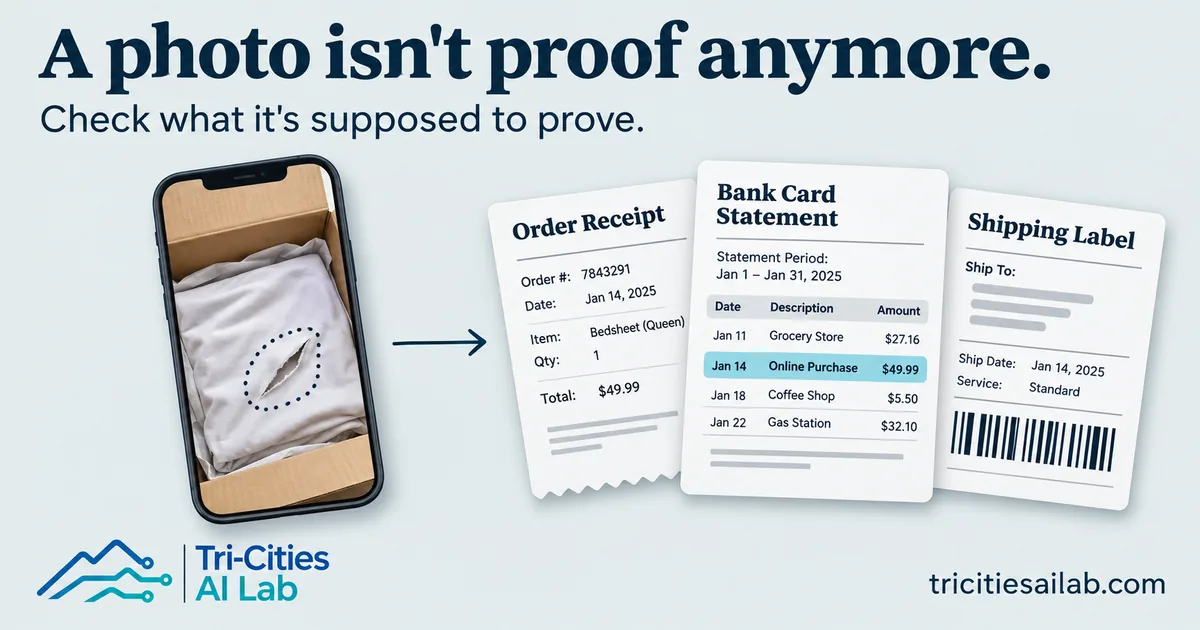
Earlier this year a Boll & Branch customer wrote in to say their sheets had arrived torn, and sent pictures to prove it. CEO Scott Tannen looked at them and saw a tear that didn't fray the way cotton frays. One of the images still had an AI watermark on it. Customer service asked for a quick FaceTime call so someone could see the sheets. The customer never answered.
Bogg, the beach bag company, had a customer complain about twisted straps. Later the same photo came back with a rip added. A manager told Modern Retail the tear didn't match how the bag's material actually tears. Bag forensics is apparently a job now. Bogg's fix was simple. When a defect claim looks off, the bag comes back before the refund goes out.
The fake doesn't have to show damage, either. Last December in Austin, a DoorDash driver accepted an order, marked it delivered right away and submitted an AI-made picture of the bag sitting at the customer's front door. The customer posted it next to a photo of his actual, empty porch. DoorDash told TechCrunch it removed the driver's account and made the customer whole. The food never left the restaurant. The picture got there just fine.
A lot of business now runs on "send me a picture"
Refund requests, warranty claims, delivery confirmations, job-done photos, expense receipts and insurance claims all lean on a photo now. For years that was a reasonable shortcut. A picture was cheaper than sending somebody out, and faking one took real skill. It doesn't anymore.
Nobody has a solid count of how often it happens. What we do have are signs pointing the same way. Verisk surveyed 1,000 U.S. consumers over the winter, and 36% said they would consider digitally editing a claim photo or document. Among Gen Z it was 55%. Verisk also surveyed 300 claims professionals, and 98% said AI editing tools are driving more digital fraud. Two caveats belong next to those numbers. Verisk sells fraud-detection tools, and "would consider" is an attitude, not a crime anybody committed.
Real cases are showing up too. In June, the North Carolina Department of Insurance charged a Greensboro woman with five felony counts of insurance fraud. Investigators allege she used an AI app to make items look badly damaged and asked for $4,876. Those are charges, not a conviction. Over in the U.K., the insurer Admiral showed the BBC claims where AI had exaggerated damage to the back of a car, and one where a license plate was moved to duplicate a claim. Admiral caught all of them and paid none of them, which is the other half of this story. The people checking more than the photo are the ones catching it.

Squinting harder isn't the plan
The natural instinct is to look closer. Count the fingers, read the background signs, zoom in on the shadows. That still catches sloppy fakes, and the good ones are getting better every month.
Detection tools help less than you'd hope, too. I tested this for a piece on my personal blog. I had Google's Gemini make a fake fender bender, posted it to Facebook and saved it back. The signed record that said "AI made this" was gone from the downloaded copy. A hidden watermark survived, but only Google's own checker can read it, and it says nothing about images from tools that don't use it. Detectors also flag real photos as fake sometimes. Kayla McCallum, an insurance attorney at Swift Currie, put the rule plainly in Claims Journal. Don't deny a claim on a software flag alone.
So stop asking whether the picture is real. Ask what the picture is supposed to prove, and check that some other way.
Check the thing behind the photo
| The photo | What it's supposed to prove | Check this instead |
|---|---|---|
| Damaged item for a refund | It arrived broken | Order history, a quick live video call, or the item itself |
| Delivery or job-done photo | The work happened | Time and location in your job app, a customer sign-off, an occasional spot check |
| Expense receipt | The money was spent | The company card statement |
| Your own claim photos | Your loss is real | The untouched original files, kept somewhere safe |
Refunds and damage claims
Do what Boll & Branch did and ask for a short live video call. An honest customer can hold the sheets up to the camera in a minute, and a fake tends to go quiet. If a call is too much, ask for one new photo with something specific in the frame, like the order number written on a sticky note or the item shot from a different side. A law firm memo from Debevoise & Plimpton suggested the same moves for insurers, multiple angles plus something in the shot for scale. For bigger claims, borrow Bogg's rule and get the item back before the money goes out.
Delivery and job-done photos
I didn't find a documented case of a local contractor faking a completed-job photo, and I'm not going to invent one. The DoorDash story shows the same trick works anywhere a photo stands in for the work. If you pay people based on pictures, tie each one to something else. If your job app stamps the time and location on photos taken inside it, use that. A customer's text saying "looks good" counts. So does a before-and-after shot from the same spot, and stopping by now and then.
Expense receipts
This one has the cleanest fix. Put spending on company cards and match every receipt to the card statement. The statement comes from the bank, not the employee. Then update your written expense policy so it names AI-made or "recreated" receipts as fabrication, which Daniel Schwartz of Shipman & Goodwin recommends. Give people an honest way to report a lost receipt, too, so nobody feels pushed to make one. AppZen, which sells expense-audit software, says the AI fakes it catches run small, around $32 at the median, so spot-check the small stuff. SAP Concur, another vendor, makes a fair counterpoint. Its view is that AI is changing how expense fraud happens more than how often.
Your own claim photos
This works in the other direction. If you're the one filing a claim, keep the original files exactly as your phone took them. Skip the filters and the AI "fix it" buttons. The Oklahoma Insurance Department warned this summer that "even small edits to enhance may trigger fraud alerts." Brightening a photo of real hail damage shouldn't get you flagged, but there's no reason to find out.
Don't punish the honest ones
Most of your customers are telling the truth. If every refund turns into an investigation, you'll lose good people over $20 pillowcases. The Debevoise memo warned insurers about overcorrecting for the same reason. So set your own dollar lines, write them down and let the checking grow with the claim.
The one thing to remember
A photo is a claim now, not proof. Check what it's supposed to prove, the order, the delivery, the purchase or the damage itself, and you won't have to win a staring contest with the picture.
If you want to see what a photo file says about itself, try the free Photo File Checkup. It runs in your browser, so the photo never leaves your device. And if you'd like help putting a refund rule or an expense policy into writing, book 15 minutes and we'll sort out where your dollar lines should be.
Sources
- Modern Retail, "From Boll & Branch to Bogg, brands are battling a surge of AI-driven return fraud," March 2, 2026. modernretail.co
- TechCrunch, "DoorDash says it banned driver who seemingly faked a delivery using AI," Jan. 4, 2026. techcrunch.com
- Claims Journal, Verisk State of Insurance Fraud study, March 17, 2026. claimsjournal.com
- North Carolina Department of Insurance, Guilford County charges, June 19, 2026. ncdoi.gov
- BBC, Admiral examples of AI-altered claims, April 15, 2026. bbc.co.uk
- Claims Journal, Kayla McCallum of Swift Currie on AI-altered claim images, May 15, 2026. claimsjournal.com
- Debevoise & Plimpton, "Use of AI-Generated Images for Fake Insurance Claims," January 2026. debevoise.com
- Daniel Schwartz, Connecticut Employment Law Blog, July 30, 2026. ctemploymentlawblog.com
- Accounting Today, "Use of AI receipts in expense fraud soars," June 23, 2026 (AppZen data). accountingtoday.com
- SAP Concur, "Fake Receipts 2.0," Dec. 16, 2025. concur.com
- Oklahoma Insurance Department, July 22, 2026. oid.ok.gov
- Dustin Lifford, "Don't Trust the Photo. Ask for the File." dustinlifford.com