

For about as long as businesses have had phones, the person answering could count on one thing about the caller. That stopped being a safe bet in September.
Last month Google, Meta, and a startup called Instinct all started letting AI assistants phone businesses on a customer's behalf. Book the table, move the appointment, ask whether the part is in stock, get a quote. The customer types what they want, the assistant dials, and your front desk ends up talking to software that is very polite and very sure about Thursday.
It's early. Almost nobody around here has the phone that can make the Google version of these calls yet. That's exactly why this is the cheap time to decide what your front desk does when the robot calls, before the first one shows up in the middle of the lunch rush.
What changed in September
Google announced an early preview of a Gemini feature called Call for Me on September 24. Gemini calls the business from the customer's own phone number, works through the phone menu, waits on hold, and then talks to whoever picks up. Google says it can check whether something's in stock, make a reservation, move an appointment, or put an item on hold. The customer can watch a live transcript and take over the call at any point.
Google has been working toward this for a while. Back in 2018 it showed off an assistant booking a salon appointment, complete with little "umms" so it would sound human. It wowed the room. This version skips the umms and tells you up front that it's a machine.
Meta launched its Muse assistant on September 8, and on September 16 a Muse engineer announced the calling beta was expanding to US businesses, starting with people who had asked for it. Reuters described Muse calling businesses to book haircuts, check whether a store had something in stock, and collect quotes from contractors.
Instinct added phone calls the same day. Its founder said the new feature can book restaurants that don't take online reservations, get a user onto their dentist's cancellation list, or sort out a cable bill. That middle one is aimed squarely at the phone at a dental office's front desk.
What the call sounds like
I couldn't find a Tri-Cities business that has reported getting one of these calls yet, so here's an illustration instead of a story. It isn't a real call. It's built from what Google says Gemini does at the start of every call. Google doesn't publish the exact wording, so the phrasing is mine.
Front desk: Thanks for calling, how can I help you?
Caller: Hi, this is Google's AI assistant, calling on a recorded line on behalf of Sarah Miller. She has an oil change scheduled Thursday at 10 and would like to move it to Friday morning if you have an opening.
Front desk: Oh. Um. Sure. I've got Friday at 9.
Caller: Friday at 9 works. Can you confirm that's still under Sarah Miller?
Front desk: It is. You're all set.
Caller: Thank you. Sarah is taking over the call now.
Sarah: Hey, sorry. While I've got you, how much are tires?
Three things in that exchange are real, documented behavior, and they're the ones your staff should know about.
- It tells you it's AI, right away. Google says Gemini opens every call by saying it's an AI assistant from Google, calling on a recorded line on the customer's behalf, and giving the customer's name. Google's terms say users can't turn that disclosure off.
- Caller ID shows the customer. The call goes out over the customer's own phone and number, so the name on your screen is a real person in your system.
- The customer may be listening the whole time. They can follow along live with their microphone muted. When they tap "Take over," Gemini announces the handoff and leaves the call.
So be nice to the robot. Its boss might be on the line.
Who's actually on the line
The same week Muse's calling beta expanded, 404 Media and Reuters both reported that Meta had been testing what it called a "human concierge" with its own employees. Some Muse call requests were handed to trained human contractors, who placed the calls themselves. Meta said this was internal testing and that calling would only roll out with proper disclosures. Reuters reported that a Meta vice president called testing contractor-placed calls without proper disclosure "a miss," and that the human-agent feature was rolled back for now.
The detail worth keeping is why they tried it. According to Reuters, some of Meta's tests showed people placing the calls got the success rate up to 95 to 98 percent, higher than the AI managed on its own. One employee reported that his insurance company kept hanging up on Muse the moment it heard it was talking to an AI. The best phone agent Meta had, at least for that week, was a person with a headset.
That's the lesson for your front desk, too. You won't always know whether the voice on the other end is software, a contractor, or the customer who just tapped "Take over." You don't have to know. The request belongs to a real customer either way.
How many of these calls to expect
Not many yet, and anyone telling you otherwise is selling something. Google's version has a long list of requirements before a single call goes out.
Google itself said it's starting small because real conversations are nuanced. For a rough sense of the starting pool, Statcounter put all Google phones at 3.16% of US mobile web traffic in September. That's every Pixel of every age, not just the newest one with a paid plan and a beta app.
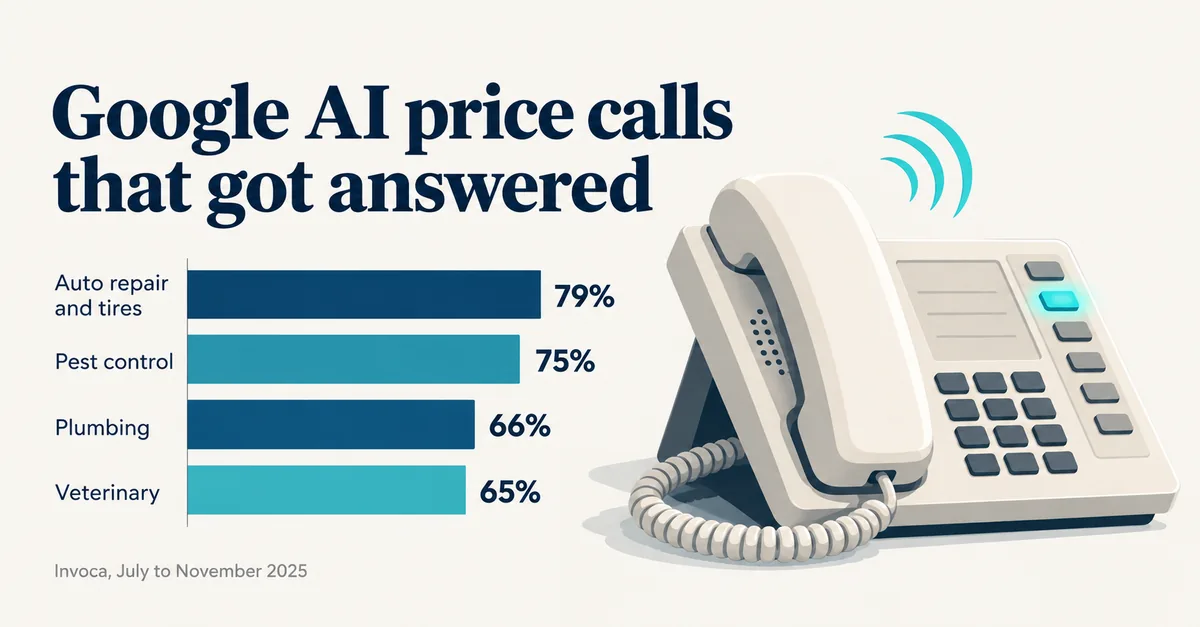
The better clue is what happened with Google's earlier, narrower version. Starting in July 2025, Google Search let people have its AI call several local businesses for prices and availability in categories like auto repair, salons, plumbing, pest control, and vets. The call-tracking company Invoca studied those calls. In late 2025 they still made up less than 1% of calls to eligible businesses, but volume jumped 324% from October to November. On average, 26% went unanswered.
Of the calls businesses did answer, nearly half ended without a price. That was most common in home services, where the answer was usually some version of "we have to come look at it." Fair enough. But Google then sends the customer a summary of what each business said, and "we'd have to come look at it" doesn't summarize well.
And there is always a next shop. When Mike Blumenthal tested that earlier feature in February 2025, one oil-change request had Google call eight shops. A tire request called 11, and five of them didn't pick up. The customer got a tidy summary of whoever answered.
Small numbers, then. That's what early looks like. Online booking and texting a business were novelties once, too, and the businesses that handled them well were the ones that decided how before it mattered.
What it won't do
Google lists what Gemini won't do on these calls. It won't call 911. It won't make payments or read out a card number, a Social Security number, a password, or health information. It won't make sales calls. Google's terms also say the feature is for personal calls only, and specifically tell users not to use it to pass health information to places like doctors' offices.
For a medical or dental office, that's a useful line. A Gemini call should be about the appointment, not the symptoms. And Google has a broader rule for its own automated business calls that works for every caller, robot or not. Google says it will never ask your business for payment, credit card information, or passwords.
On recording, Tennessee and Virginia are both one-party consent states, and Gemini announces the recording at the start of every call anyway.
One caution. Meta and Instinct don't publish what their assistants say at the start of a call, so don't assume every AI caller will introduce itself the way Google's does.
Five decisions for your front desk
None of this needs software or a vendor. It needs about ten minutes and whoever answers your phone. Here are the decisions, with a sensible default for each.
| Decision | The question | A sensible default |
|---|---|---|
| 1. Do we take it? | Will we handle a request from an AI caller the same as one from the customer? | Yes. A real customer sent it, from their own number, with their name attached. |
| 2. What do we share? | What will we tell an AI caller, and what won't we? | Hours, availability, and booking details, yes. Card numbers, account details, and anything medical, no. Same as you'd do with any caller you can't see. |
| 3. What about prices? | What do we say when it asks for a quote we don't give over the phone? | Give whatever you can stand behind, like a range, a starting price, or a diagnostic fee, plus the next step. "We'd have to see it" doesn't summarize well next to a competitor's number. |
| 4. How do we confirm? | How does the customer know the booking is real? | Send your normal confirmation text or email to the customer's number. Gemini calls from that number, so the confirmation lands with the actual person. |
| 5. When do we hand it back? | What happens when the request gets complicated? | Ask for the customer. Gemini lets them take over mid-call. If they can't, offer a callback or your text line. Jot "booked by AI" on the appointment so a no-show makes sense later. |
Should you opt out?
You can, and it's worth knowing there are two separate switches.
For the new Gemini Call for Me calls, Google has an opt-out page where you enter your business number, verify it with a code sent by text or call, and add it to a block list. For Google's older automated calls made through Search and Maps, the switch lives in a verified Google Business Profile under Advanced settings, in a section called "Google automated calls and text messages." That older feature is available in every US state except Indiana, Louisiana, Minnesota, Montana, and Nebraska. Tennessee and Virginia are both in.
Flipping one doesn't flip the other. And neither one stops a customer from wanting to book with you. It just stops one of the ways they asked.
My take is to leave both on unless the calls actually become a problem. Opting out because the caller is unusual is a lot like not answering because you don't recognize the number. Sometimes that's smart, and sometimes it was a customer.
Two related myths while we're here. Having online booking doesn't guarantee Google won't call, because Google says it may book through your booking partner or call you directly. The one thing Google says reliably stops its inventory calls is listing your in-store products in Google Merchant Center. And if you run Google Local Services Ads, Google says missed calls can hurt your responsiveness in that ad ranking. That's about the paid ads, not your regular spot on the map.
The one thing to do this week
Write down your answers to those five decisions and put them next to the phone. That's it. The first AI call to your business will probably be a little awkward no matter what. It's a lot less awkward when the person answering already knows the plan.
If you'd like help writing that one page, or you want to see what your Google profile is telling these assistants about your business, text me at (423) 967-5584. Every text is read by me, not a bot.
Sources
- Google Gemini Help: Ask Gemini to handle your everyday phone calls
- Google: Gemini Apps Agentic Calling Additional Terms of Service
- Google: Gemini Apps Privacy Hub (agentic calling section)
- Google: Gemini calling opt-out page
- Google Business Profile Help: About automated calls and texts from Google to your business
- Google Local Services Help: About ad rankings
- TechCrunch: Google tests letting Gemini call businesses for you
- TechCrunch: Rival AI agents Instinct and Meta's Muse both add the ability to make calls
- Meta: Introducing Muse
- 404 Media: Meta tests Muse AI agent calls that are actually made by humans in a call center
- Reuters (via KSL): Meta testing a "human concierge" for its new personal AI agent, Muse
- Invoca: Google AI pricing calls study
- Invoca: Press release on Google AI pricing calls
- Search Engine Journal (Mike Blumenthal): Google's new Ask for Me reviewed
- Statcounter: US mobile vendor market share
- Tennessee Code 39-13-601
- Code of Virginia 19.2-62