

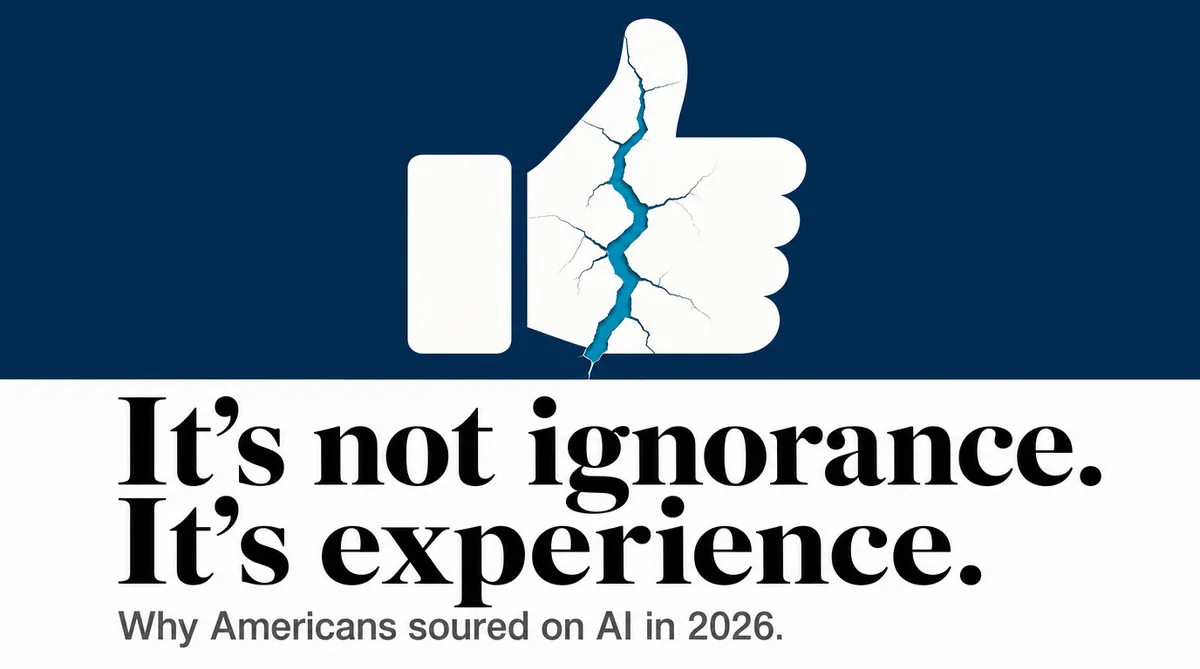
Familiarity with AI went up. Comfort went down. That is not an education problem. It is an implementation problem, and the difference matters if you run a business here.
Gallup published new numbers on July 28. Seventy percent of Americans now say they are at least somewhat knowledgeable about AI, up from 64% in 2024. Over the same stretch, the share who think AI does more harm than good climbed to 39%, up from 31% last year. Nine percent think it does more good than harm.
The standard assumption in technology is that people warm up once they understand a thing. Two years of data just went the other way.
The explanation offered in the coverage came from Anton Dahbura at Johns Hopkins, who called it partial familiarity. People are judging AI off one narrow slice, he said, rather than the full picture. The applications that actually impress, faster drug discovery, better materials, more efficient energy use, do not show up on anybody's phone at eleven at night.
He is not wrong about the slice. I think he is wrong about what it means. When you go looking for where the negativity comes from, you do not mostly find ignorance. You find people who have accurately assessed the AI that companies chose to put in front of them, plus a reasonable fear about what happens next that nobody has answered with a credible safety net.
Those are different problems and only one of them is yours to fix.
The most visible AI is customer service, and it is often bad
For a lot of people, the most memorable AI a company has put directly in their way is a support chatbot.
SurveyMonkey found 79% of consumers would rather deal with a human than a chatbot. The reasons are specific rather than vague: people say humans understand what they need (61%), explain things more fully (53%), and frustrate them less (52%). Compiled consumer research puts the top chatbot complaint as the bot not understanding the request, followed by not being able to escalate to a person. Three quarters rate the ability to reach a human as very important, not merely important.
The nuance worth keeping is that people do use self-service willingly when it works. Centrica said in July that more than 90% of British Gas customers start in a digital channel and that call volume fell 20%. The chief executive read that as preference. It is at least evidence that automated service is not universally rejected, though a utility cutting 1,300 jobs has an obvious interest in that reading.
So the failure is narrower and more useful than "people hate chatbots." A bot that answers a routine question is fine. A bot that cannot understand you and will not let you out is the company telling you what your time is worth. Escalation is part of the product, not a fallback.
The output is often cheap, and sometimes wrong in ways that cost money
The advertising data has one finding that should stop anybody about to buy an AI content package. The IAB surveyed both sides of the transaction. 82% of ad executives believed Gen Z and Millennial consumers feel positive about AI-generated ads. Only 45% of those consumers actually did. The gap widened from 32 points in 2024 to 37 points in 2026. The people producing this material are getting worse at reading their audience, not better.
Harris Poll research with the 4As and Infillion, presented at Cannes in June and fielded globally, found 78% of consumers say AI makes ads feel less authentic and 63% would be less likely to buy from a brand using AI-generated ads. Macquarie Dictionary named "AI slop" its word of the year for 2025. Not innovation. Slop.
The same IAB research contains a useful counterpoint, though. 73% said disclosure that an ad used AI would either increase their purchase likelihood or leave it unchanged. The problem is not simply that AI touched the work. Concealment, quality, and judgment are what move people.
Aesthetics are the small version of this problem anyway. The expensive version is a confident factual error about your business.
The Viridian Bookshop in Willoughby, Ohio spent July 2026 fighting a Google AI summary that told some users the shop was permanently closed and listed the wrong street address. Anna Mae's Bakery in Millbank, Ontario had an AI overview announce it would close permanently on July 31, apparently confusing it with an Illinois business of the same name. Customers called, emailed, and walked in to ask if it was true. A restaurant in Wentzville, Missouri asked patrons to stop using Google AI to find its specials after the summaries invented prices it never offered.
Tennessee did move on something adjacent, and almost nobody has noticed. Public Chapter 858, effective July 1, gives a Tennessee business with 50 or fewer full-time employees a request-and-response process when a search engine reduces its visibility, removes its listing, or removes at least a quarter of its reviews. The company generally has five business days to explain or provide appeal steps, and a business can sue if it does not. Read the scope carefully, because it is narrower than it first sounds. It addresses listings, visibility, and reviews. It does not clearly give you a remedy for a false AI summary.
The payoff is real, uneven, and almost never measured
This is where I have to be careful, because the easy version of this section is wrong.
The number that made the rounds is MIT's finding that roughly 95% of enterprise AI pilots showed no measurable effect on profit and loss. That figure is preliminary, not peer reviewed, built from 52 interviews and 153 executive surveys, and it defines success narrowly. It has been badly overread.
The honest picture is messier and more useful. Peer-reviewed work does find real gains in bounded tasks. A large study of customer support agents published in the Quarterly Journal of Economics found roughly 15% more issues resolved per hour with an AI assistant, with the biggest gains going to the least experienced workers. A controlled writing study in Science found faster completion and higher rated quality. BCG's June survey of close to 12,000 workers globally found that 42% of regular frontline users report saving eight hours a week or more, and more than two thirds of regular users report higher job satisfaction.
And then there is a finding that helps explain why desk-level savings may not become organization-level value. In that same survey, 66% of frontline workers who saved time got limited or no guidance about what to do with it. More than half say they are not redirecting it toward anything strategic. Only 36% felt adequately trained. BCG sells AI transformation consulting and these are self-reported figures, but the management gap it describes is still instructive.
Set that next to the METR trial, where sixteen experienced developers predicted AI would make them 24% faster, were measured 19% slower, and still estimated afterward that they had been 20% faster. METR now calls that result historical and says later estimates are muddied by who volunteered, so it is not the last word on AI and coding. It is a permanent word on self-assessment. Those developers were not lying. They could not tell.
So the defensible claim is not that AI does not deliver. It is this: gains are real at the desk, frequently invisible above it, and nobody can feel the difference reliably enough to skip measuring it. If your only evidence that a tool saved you time is that it felt faster, you have exactly the evidence those developers had.
A small operation may have one real advantage here. There are fewer layers between time saved and something a customer actually notices. If a tool gives your office manager back four hours, you have a reasonable chance of knowing where those hours went by Friday. A company with six approval layers between the saved hour and the delivered service does not.
The transition has no income attached to it
This is the part driving the fear, and it is the part where the public read is most accurate.
Gallup has 79% of Americans expecting AI to reduce U.S. jobs over the next decade, up from 73%. Among adults 18 to 29 that jumped thirteen points in a single year. Pew found 67% have little or no confidence in the federal government to regulate AI effectively, and about two thirds say the technology is moving too fast.
Here is what those people are looking at.
There is no federal law requiring an employer to disclose whether AI factored into a mass layoff. The federal wage insurance program with published evidence that it improved reemployment and earnings, the one attached to trade adjustment assistance, lapsed in 2022. A study of more than 23 million records from the main federal retraining program found it rarely moved workers into less automatable work. A separate bipartisan bill that would require reporting AI-related layoffs to the Labor Department has not advanced.
Something did happen this week, to be fair to Congress. On the afternoon of July 29, the same day the Gallup coverage ran, a Senate HELP subcommittee held a hearing on AI and the workforce, examining the bipartisan AI Workforce PREPARE Act, introduced in December. Until this week it had gone no further than committee referral. Chairman Jim Banks framed part of the hearing around making sure small and midsize businesses are not left behind while the largest companies race ahead.
Read what the bill does, though. It builds better data collection, forecasting capacity, research hubs, training analysis, and a WARN disclosure requirement covering AI's role in covered layoffs. That is genuinely useful infrastructure for seeing the problem and preparing for it. It is not wage insurance, replacement income, or a safety net.
Tennessee's own 2026 session tells a similar story. One new law directs a state commission to report on AI by January 31, 2027. Another orders a broader regulatory study with no reporting deadline attached. A third bars anyone from marketing an AI system as a qualified mental health professional, which is a real consumer protection. Those are meaningful steps in research and consumer protection.
So when a 34-year-old in Bristol says nobody has a plan for this, the correct response is not reassurance. He has read the same box score.
What the local numbers actually say
I went looking for Tri-Cities data on this and mostly found an absence, which turns out to be the finding.
Federal occupational estimates do show movement. From May 2023 to May 2025, office and administrative support employment fell about 12.5% in the Johnson City metro and about 3.4% in Kingsport-Bristol, while total employment was roughly flat in Johnson City and up about 3% in Kingsport-Bristol. Some clerical categories dropped hard. Medical administrative employment, meanwhile, grew substantially in both metros.
That last detail matters, and it is why I am not going to tell you AI did this. These are survey estimates with real sampling error, detailed occupations bounce around, and a category that more than doubles in two years is a warning to check classification and methodology before treating it as literal economic change. Business closures, health care demand, outsourcing, and ordinary restructuring all live in those numbers too.
Meanwhile the region's WARN notices from this year, covering a plant closure in Erwin, a Johnson City layoff, a closure in Telford, and a multi-site reduction, name a lot of causes. None of them names AI. That is partly by design, because the notice does not ask.
The honest local summary is this. Some occupations considered highly exposed to automation were already shrinking here inside a much longer decline in clerical employment. The public data cannot separate AI from everything else, and no local number exists that would settle it. Which is exactly why people here are running on national headlines. There is nothing regional to run on instead.
Fact and fiction
| Claim | Verdict |
|---|---|
| AI is already causing economy-wide job losses | Not established. Yale's Budget Lab, working with Brookings, still finds no clear aggregate effect. Concentrated effects can be real without showing up here. |
| Employers are blaming AI for layoffs | Fact. Challenger counted AI in 101,743 announced U.S. job cuts through June, about 23% of the total, nearly double all of 2025. |
| Those announcements prove AI caused the cuts | No. Challenger tracks what employers say. Employers have incentives both to overstate AI's role, which makes ordinary cost cutting sound inevitable, and to understate it, which avoids resistance and scrutiny. |
| Northeast Tennessee is recording AI layoffs | Not found. No local WARN notice cites it. The form does not ask. |
| Entry-level work deserves particular concern | Best-supported worry on the board. Stanford's payroll research found a relative employment decline for 22-to-25-year-olds in highly exposed occupations. Treat it as an early signal, not a national body count. |
| AI cannot improve productivity | False. Peer-reviewed studies find real gains on bounded tasks. |
| AI adoption reliably pays off | Not established. Exposure, usage, time saved, and profit are four different things. |
| Nobody in government is doing anything | Too broad. There was a hearing this week and Tennessee ordered studies. Neither one replaces income. |
What a business here can actually do
Six things, none of which require a new budget line.
Automate the filing, not the deciding. Consistent across every piece of evidence above. People will accept AI as competent. They will not accept it as the last stop.
Keep the escalation path. If a customer cannot reach a person, you have not deployed a tool. You have installed a wall.
Say where the human is, in writing. One short paragraph naming who reviews the output and who owns the decision when the tool is wrong. With only 27% of Americans trusting businesses to use AI responsibly, identifying your reviewer is a practical trust signal, and the IAB disclosure finding suggests it costs you nothing.
Check what AI says about you. Ask the major assistants for your hours, your address, your services, and whether you are still open. The bookstore in Ohio found out from a customer. Document anything wrong, and know that Public Chapter 858 covers listings, visibility, and reviews rather than hallucinated facts.
Retrain in place, because here it is also cheaper. In a labor market where East Tennessee employers already report real difficulty filling positions, the person who knows your customers and your paperwork costs more to replace than to teach. It also addresses part of the transition concern sitting behind Gallup's job-loss number.
Measure it or drop the claim. Baseline the time, the cost, and the error rate. Run the pilot with an end date. Compare. If it did not work, that is an answer, and it is worth more than a feeling.
The takeaway
Trust does not come back by convincing anybody to like AI. It comes back from using AI in fewer, better-chosen places, with a name attached to the result and a number behind the claim.
Twenty-seven percent of Americans trust businesses to use AI responsibly. That is a low bar and a real opportunity. The national brands generating that distrust are too large to be specific with anyone. You are not. You can tell a customer exactly who checked the work, and be telling the truth.
If you run something in Kingsport, Johnson City, or Bristol and want to test that on one workflow, I will help you map it, decide what to automate and what to leave alone, and measure it against a real baseline. If it does not work, I will tell you that. With your permission, I will also publish what the pilot taught us, including the failures.
- Gallup, "Americans Cool Toward AI," July 28, 2026 (Bentley University-Gallup Business in Society; 3,270 U.S. adults, fielded May 4 to 11): news.gallup.com
- Pew Research Center, "Americans and AI 2026": pewresearch.org
- IAB, "The AI Ad Gap Widens": iab.com
- The Harris Poll with the 4As and Infillion, Cannes Lions 2026: theharrispoll.com
- SurveyMonkey, customer service statistics: surveymonkey.com
- Reuters on Centrica's digital channel figures: reuters.com
- Brynjolfsson, Li, and Raymond, Quarterly Journal of Economics: academic.oup.com
- Noy and Zhang, Science: science.org
- BCG, "AI at Work: Why Strategy Matters More Than Tools," June 3, 2026: bcg.com
- METR, "Measuring the Impact of Early-2025 AI on Experienced Open-Source Developer Productivity": metr.org
- Stanford Digital Economy Lab, "Canaries in the Coal Mine?": digitaleconomy.stanford.edu
- The Budget Lab at Yale, "AI Is Probably Not (Yet) the Reason for Labor Market Weakening": budgetlab.yale.edu
- Challenger, Gray & Christmas, June 2026 job cut report: challengergray.com
- AI Workforce PREPARE Act, bill text: govinfo.gov
- U.S. Senate HELP Subcommittee hearing, "The Impact of AI on the Workforce," July 29, 2026: help.senate.gov
- Workforce Innovation and Opportunity Act participation study, May 2026 preprint: arxiv.org
- BLS Occupational Employment and Wage Statistics, metro estimates, May 2023 and May 2025: bls.gov
- Tennessee Department of Labor and Workforce Development WARN archive: tn.gov
- News 5 Cleveland on the Viridian Bookshop: news5cleveland.com
- Anna Mae's Bakery correction: facebook.com
- First Alert 4 on the Wentzville restaurant: firstalert4.com
- Tennessee Public Chapter 647 (HB 1470): wapp.capitol.tn.gov
- Tennessee Public Chapter 1066 (SB 1493): wapp.capitol.tn.gov
- Tennessee Public Chapter 1082 (SB 1700): wapp.capitol.tn.gov
- Tennessee Public Chapter 858 (SB 2262/HB 2028): wapp.capitol.tn.gov