

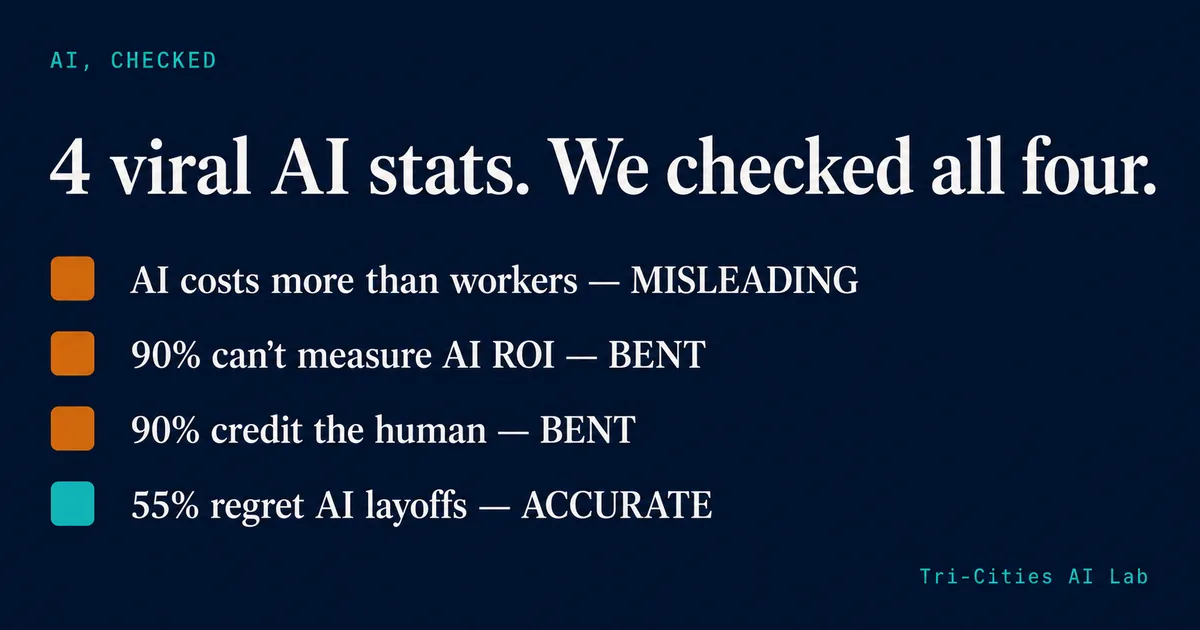
Two things are moving through business feeds this week. One is a run of headlines about companies quietly walking back AI-driven layoffs. The other is a screenshot on LinkedIn with four alarming numbers about AI costing more than the people it replaced. If you have felt uneasy about the nonstop AI push, both are easy to forward and feel proven right.
We did the boring part first. We traced all four numbers back to the original research, not the reposts. Three of them are real but bent on the way to your feed. One is basically accurate. And underneath the noise is the part that actually helps a local business: a clear, repeatable way to use AI that the companies in the headlines skipped.
Here is where each number lands.
1. "AI costs more than the workers it replaced" Misleading
The real story is narrow. It starts with one honest quote from an Nvidia executive who said that for his own team, computing now costs more than the people. His team trains frontier AI models, which burns an enormous amount of compute. That is not a normal office. The scary version takes that one situation and stretches it over every company and every tool.
The math does not support the stretch. Even the worst runaway AI bills, the ones that made news when firms like Uber blew through a yearly budget in months, ran a few hundred to a couple thousand dollars per engineer each month. The engineer that AI was supposed to replace costs many times that once you count salary and benefits.
Sources: Axios (Nvidia), reporting on enterprise token overruns. Monthly figures are illustrative of the gap, not a single company's books.
So the real problem is not that AI is more expensive than people. It is that usage-based AI pricing can spike without warning when nobody is watching the meter. That is a budgeting and oversight problem, and a fixable one.
2. "90% don't know if AI is saving or costing them money" Bent
This traces to the Lanai 2026 AI Labor Report, a survey of 200 technology executives at large companies. What it actually found: 90% of organizations have no single team responsible for tracking whether AI delivers a return. And 92% say they track AI's impact, but only 2% record most of that work as a real business outcome.
That is not the same as "we have no idea if it helps." Companies know what AI costs them. What they cannot do is connect that spending to a specific result. The same survey found more than half of executives believe most of their automated work runs through tools their own IT team never approved, so no one can even see it, let alone measure it. It is a measurement gap, not total blindness, and it is exactly the gap a small business can avoid by setting a baseline before it starts.
3. "Almost 90% credit AI-assisted work to the human, not the AI" Bent
Same survey. The real figure is 87%, rounded up to "almost 90." And it is about credit inside performance and pay systems: when a person uses AI to help produce work, the finished work gets logged to the person, because no system was built to record it any other way. It is not a grand statement that humans create all the value. It is a recordkeeping habit. Useful to know, easy to over-read.
4. "55% of companies that laid off workers for AI regret it" Accurate
This one holds up, and the wording in the post is careful. It traces to a survey of 1,163 business leaders by the workforce firm Orgvue. Of those, 39% had made layoffs because of AI. Of that group, 55% said it was the wrong call. A separate forecast from Forrester landed on the same 55%.
Source: Orgvue 2025 survey of 1,163 leaders, fielded February to March 2025. Forrester's Predictions 2026 reached the same 55%.
Two small notes. The number applies to the companies that already made AI-driven cuts, not to every company, and the post gets that right. The "MoneyWise" tag is loose; the number comes from Orgvue and Forrester. Otherwise, accurate.
The part that actually matters
Strip away the framing and the four numbers are not really about AI failing. They are about what happens when a company points AI at a whole job instead of a specific task, and removes the people who held the judgment. Forrester adds a detail worth sitting with. In roughly nine out of ten of those AI-layoff announcements, there was no working AI system in place yet. People were cut for what the tool might do later.
That is the thread through the real reversals. When Commonwealth Bank of Australia replaced part of its call center with a voice bot, call volume went up, not down. The bank ended up paying overtime and putting team leaders back on the phones, the finance sector union challenged the cuts, and the bank apologized and reversed them within weeks. Klarna leaned its customer service too far onto AI, watched quality slip, and rebuilt a human option. Its own line now is that AI gives it speed while people give it empathy. In both, AI could handle the routine slice. The hard slice, the disputes, the edge cases, the moments that need a person, is where the value actually lived.
The companies doing it well run the opposite play. Ford did not fire engineers for AI. It found that automated quality checks alone missed what veteran engineers catch, so it brought that judgment back to lead reviews and improve the tools. IBM automated the routine 94% of HR questions and kept people on the 6% that need judgment, cut HR costs by 40% over four years, and is growing hiring, not shrinking it.
The IBM AskHR model: automate the task, keep the human on the exceptions, measure the savings. Source: IBM.
What actually works
The research is consistent, and it is not a vendor talking. When frontline support workers were given an AI assistant, productivity rose about 14%, with the biggest gains for the least experienced staff. A Harvard and BCG study found the same edge inside AI's strengths, workers finished more tasks, faster, but on problems outside those strengths, AI users were 19% more likely to get it wrong.
Sources: NBER field study of about 5,000 support agents (Brynjolfsson, Li, Raymond); Harvard and BCG "jagged frontier" study of 758 knowledge workers (Dell'Acqua et al.).
That is the whole lesson in one picture. AI helps a lot on the right tasks and hurts on the wrong ones, so a person has to stay on the exceptions. The bigger studies land in the same place. Less than 5% of jobs can be fully automated, but most contain a slice of work that can be, so AI tends to change jobs rather than erase them. The same report that produced the scary "90%" numbers also found that 100% of these companies still require a human to review AI's work. None run it unattended. And at the market level, the firms most exposed to AI grew wages and headcount faster than everyone else. They did not shrink. Workers with AI skills command about a 56% pay premium. The winners used AI to make people more valuable, not to remove them.
A different experience at the Lab
You are not Ford, and that is the point. A local business does not risk a 700-seat mistake. The risk here is smaller and quieter: paying for AI tools that never prove their worth, or unreviewed AI output going out under your name. Both are avoidable.
| The approach that led to regret | The approach we use |
|---|---|
| Hand AI a whole job, remove the people | Hand AI one bounded task, keep the person |
| Output ships unreviewed | Every output is human-reviewed before it goes out |
| "It is more efficient," never measured | Time and money saved, measured against a baseline |
| The people who held the context are gone | The people who hold the context stay and direct the tool |
The way we work at Tri-Cities AI Lab is the boring, effective version. We pick one task that eats your time. We point AI at that task, not at a person's job. We keep a human reviewing the output before it reaches a customer. And we measure the time and money saved against a real starting point, so you are never in the 90% who cannot tell if it helped.
The one takeaway
The companies that got burned deleted the job before they knew which parts still needed a person. The ones that win automate the task, keep the human on the judgment, and measure what it saved. That is the whole difference, and you can start on the right side of it.
Sources
- Axios, "AI can cost more than human workers now" (Apr 26, 2026): axios.com/2026/04/26/ai-cost-human-workers
- Lanai 2026 AI Labor Report (Jun 9, 2026): prnewswire.com (Lanai 2026 AI Labor Report)
- Forbes, Guney Yildiz, on AI accounting gaps (Jun 24, 2026): forbes.com/sites/guneyyildiz
- Orgvue, "55% of businesses admit wrong decisions" (Apr 29, 2025): orgvue.com/news
- Forrester Predictions 2026, via HR Executive: hrexecutive.com
- Companies reversing AI layoffs (Ford, CBA, IBM), CNBC (Jul 1, 2026): cnbc.com/2026/07/01
- IBM AskHR case study: ibm.com/case-studies/ibm-askhr
- PwC Global AI Jobs Barometer: pwc.com/ai-jobs-barometer
- "Generative AI at Work," Brynjolfsson, Li and Raymond (NBER working paper, later Quarterly Journal of Economics), field study of about 5,000 support agents.
- "Navigating the Jagged Technological Frontier," Dell'Acqua et al. (Harvard Business School and BCG, 2023), study of 758 knowledge workers.
- McKinsey Global Institute automation research: less than 5% of jobs fully automatable; most contain automatable tasks.
- Gartner via Fortune, on AI layoffs showing no ROI correlation and "people amplification" gains (May 2026): fortune.com/2026/05/11
Want the real numbers for your own business instead of a viral stat? Start with an AI Strategy conversation, or tell us what is slowing you down.