

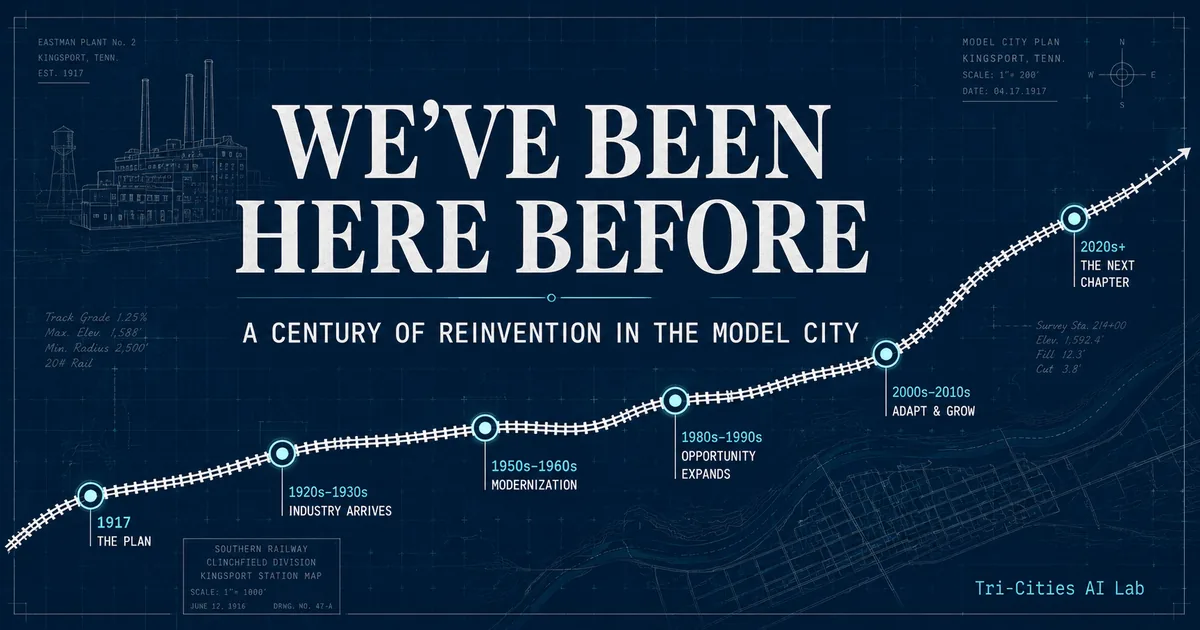
Kingsport has been adapting to new technology since before it was legally a city. AI is just the next chapter.
Most people talk about AI like it is something happening to Kingsport. Another wave rolling in from somewhere else, aimed at somebody's job, somebody's business, somebody's kid.
I want to make the opposite argument. This region has spent more than a century meeting new technology head on, learning it, and putting it to work, and it is quietly doing the same thing with AI right now. But to understand how deep that habit runs, you have to start with the one time we didn't.
Here is the part nobody puts on the welcome sign. Kingsport has already died once.
The original town, an actual working river port, incorporated back in 1822 when the settlements of Christianville and Rossville merged. Flatboats loaded at the Boat Yard and floated goods down the Holston toward markets we could reach and the rest of the world could not. Then the first railroads came through the region in the mid-1800s and went to Bristol and Johnson's Depot instead. Commerce followed the rails, the Civil War finished the job, and Kingsport lost its municipal charter entirely. For roughly four decades, Kingsport was not a struggling town. It was legally not a town at all.
That is the before picture, and it is the last sad paragraph in this story. So when I say we've been here before, I do not mean it as a figure of speech. This community ran the experiment on letting a new technology pass it by exactly once, then spent the next hundred years making sure it never happened again. That century of saying yes is the real story of this region, and it is why AI is not a wave rolling in to break over us. It is the next tool on a very long workbench.
Here is the whole line, from the river to right now. Then let's ride it.
1822 to today
A Century of Reinvention
Every stop on this line is a technology this region learned. Tap a stop for the full story.
-
Flatboats loaded at the Boat Yard carried goods downriver to southern markets, and the town incorporated in 1822. Then the railroads passed the river port by, commerce moved to Bristol and Johnson's Depot, and after the Civil War, Kingsport lost its charter entirely. For four decades it was barely a town at all.
Kingsport has already died and come back once.
The river was this region's first advantage. The hard lesson was what happens when the next one gets built somewhere else.
-
Fifty-five tunnels blasted through some of the hardest terrain on the continent made the Clinchfield one of the costliest pieces of engineering of its era. Once trains were running, the railroad's backers started recruiting companies that needed coal, timber, water, and a way to ship finished goods.
The pitch that rebuilt this city was written around a rail line.
New infrastructure came first. The city was built around it.
-
Nolen zoned commerce, churches, housing, and industry, drew some of the country's earliest traffic circles, and centered the whole design on Church Circle. Kingsport also became the first Tennessee city run by a city manager. Historians call it the first diversified, professionally planned, privately financed city of twentieth-century America.
The nickname traces to the National Civic League's 1915 Model City Charter, the good-government blueprint Kingsport adopted. The Model City was a governance decision before it was ever a postcard.
This city did not grow by accident. It was engineered.
-
Tennessee Eastman started with 35 acres, a half-finished factory, and $3.5 million. First-year sales were $35,000, and the plant lost money for years before it found its footing, surviving partly by pressing waste charcoal dust into briquettes.
The company that came to define this region began as a struggling startup.
The biggest bet in Kingsport history looked shaky for a decade.
-
A book from Kingsport Press used paper milled across the street at what became Mead, bound in cloth from Holliston Mills, woven from fabric made at Borden Mills. The Press's first order in 1923 was 50,000 New Testaments, and by the 1950s it was the largest complete book manufacturer in the world.
Within a decade of the charter, ten manufacturers employed more than 3,300 people, and Kingsport kept growing straight through the Great Depression.
Connected businesses survive what isolated ones cannot.
-
Holston Ordnance Works went from 200 workers to about 6,800 in two years, and nearly half of them were women, some qualifying through crash chemistry courses at what became ETSU. Eastman's reputation for getting hard things done led General Leslie Groves to hand the company the Y-12 plant at Oak Ridge, part of the project that built the atomic bomb.
Holston still operates today as the Holston Army Ammunition Plant.
When the stakes were highest, the country called Kingsport.
-
The energy crisis of the 1970s threatened every petroleum-based ingredient Eastman relied on. The answer was under the region's own mountains. Convert Appalachian coal into synthesis gas and cut oil out of the recipe entirely. The plant opened in 1983, the first of its kind in the country.
It may be the most East Tennessee solution ever engineered.
When the inputs got scary, this region changed the inputs.
-
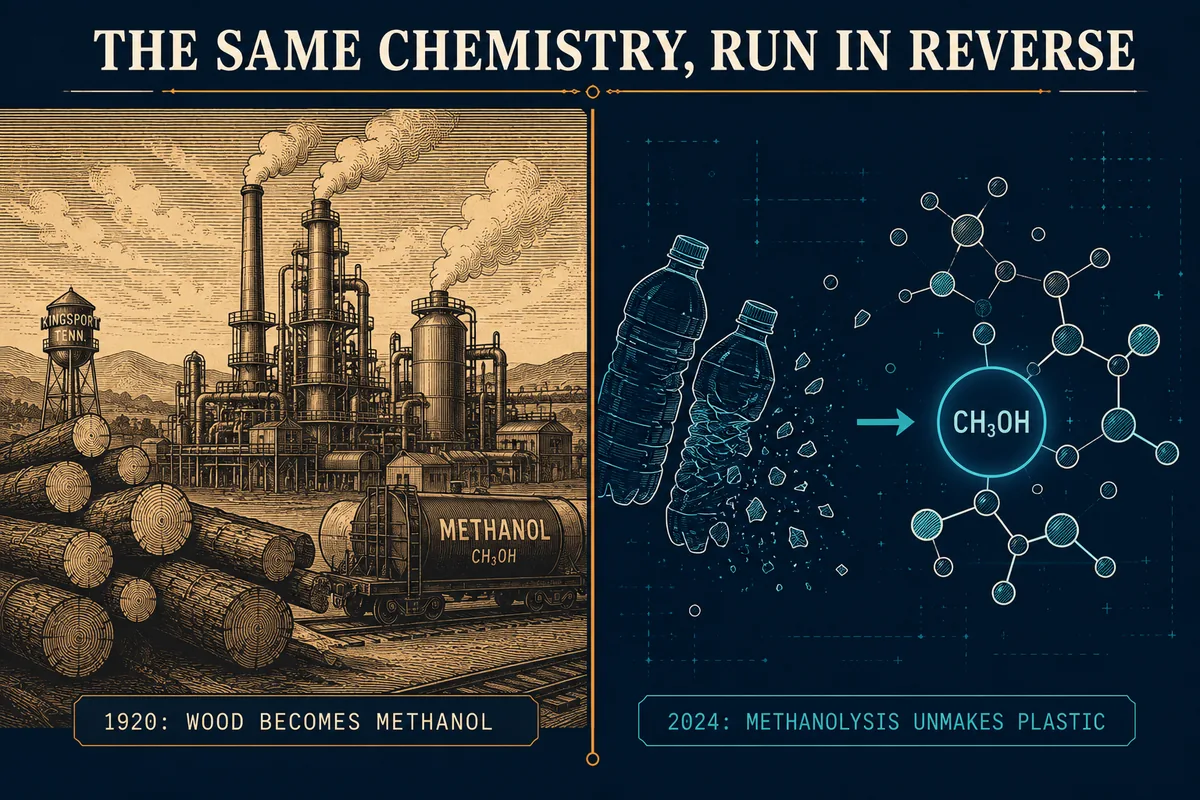
On day one it was already the tenth largest chemical company in the United States. Today Eastman runs a methanolysis facility in Kingsport, one of the biggest molecular recycling plants in the world, that breaks waste plastic back down into raw material.
A company that began by making methanol from Appalachian hardwood now uses the same chemistry, in reverse, to recycle.
Reinvention is not a phase here. It is the business model.
-
Not every industry made the turn, and pretending otherwise would sell the story short. But the region's businesses moved online, the city pushed multi-gigabit fiber to its front doors, and the old Press site downtown now holds a hand-carved carousel. Its identity outlasted the smokestacks that once defined it.
Adapting is not painless. It is just better than the alternative.
-
AI is not bigger than the railroad, and it is not the next Eastman. It is a tool, and it is already quietly at work. Eastman has run AI-driven predictive maintenance since 2021, and a new state grant is building an AI and data science credential for high schoolers in Kingsport and Sullivan County. This region has a hundred-year track record of learning new tools instead of running from them.
The advantage was never cheap land or rail access. It was people willing to learn.
We have been here before.
Sources: Tennessee Encyclopedia, Kingsport centennial archives, Eastman records, Clinchfield.org, Kingsport Public Library.
The railroad that restarted a city
George L. Carter was not trying to found the Model City. He was trying to move Virginia coal to the Atlantic. But his Carolina, Clinchfield and Ohio Railway, completed through here in 1909, was no ordinary coal road. Fifty-five tunnels blasted through some of the meanest terrain on the continent, and measured in constant dollars, the most expensive railroad ever built in America.
Once the trains were running, the railroad's financial backers looked at the spot where the rails crossed the Holston, where water, timber, and coal all met in one valley, and started recruiting. They marketed the site to companies that needed raw materials coming in and a way to ship finished goods out.
Nobody wrote a mission statement about embracing emerging technology. They laid track, and then they made phone calls. The pitch that rebuilt this city was written around a rail line.
A city designed on purpose
By 1907, a Johnson City newspaper was reporting that national investors intended to "boom a town" here. When Carter's finances tightened, John B. Dennis of the Wall Street firm Blair and Company took over the townsite project, teamed up with local merchant J. Fred Johnson, and formed the Kingsport Improvement Corporation. They hired John Nolen, one of the most respected city planners in America, to design the whole thing from scratch.
Nolen zoned it deliberately, putting industry along the river and rails, commerce up Broad Street, and churches and homes on the higher ground, all of it anchored on Church Circle. His plan included some of the first traffic circles in the United States, which means Kingsport drivers have been mad about roundabouts longer than almost anybody in the country. We were early adopters of that too.
In 1917 the city re-chartered, and here is a detail most of us got wrong our whole lives. The "Model City" nickname may owe less to the pretty street plan than any of us assumed. Jeff Fleming, who spent 35 years working for this city and rose from planning intern to city manager, wrote about it just this month. The name tracks to the National Civic League's 1915 Model City Charter, a blueprint for professional, nonpartisan city government. Kingsport adopted it and became the first city in Tennessee run by a professional city manager. The Model City was a governance decision before it was ever a postcard.
Historian Margaret Ripley Wolfe, who wrote the definitive book on this town, calls Kingsport the first American city of the twentieth century that was professionally planned, privately financed, and deliberately diversified all at once. Not a company town. Not an accident. A design.
And because this story does not need airbrushing to be impressive, let's say the honest part plainly. The same plan that gave us Church Circle also confined the city's Black residents to small, crowded lots near the industrial zones, and the green spaces in Nolen's drawings mostly stayed in the drawings. A model is a plan, and plans carry the assumptions of the people who draw them. The founders built something remarkable. They did not build it for everyone equally, and both of those things are true.
The bet that looked bad for a decade
During World War I, Germany cut off the chemicals that Eastman Kodak needed to make film. George Eastman decided he would never again depend on a supply chain he could not control, and he went looking for methanol.
Meanwhile, the federal government had built half a wood-distillation plant in Kingsport for wartime chemical production, and when the war ended, Washington did what Washington does with half a factory. It walked away.
J. Fred Johnson, who by all accounts could sell rain to a river, got Kodak's scouts down here in early 1920. Eastman visited that July, bought the 35 acres and the unfinished buildings, and on July 17, 1920, incorporated Tennessee Eastman with 3.5 million dollars in capital.
First-year sales: 35,000 dollars.
The plant lost money for years and survived partly by pressing its waste charcoal dust into briquettes. The company that would come to define this entire region spent its first decade as, among other things, a grill fuel operation.
And here is the detail that carries the whole story. The technology Eastman actually came here for, distilling chemicals out of wood, was priced out within about a decade by cheaper synthetic methanol.
The founding technology died almost immediately. The company lived because it treated the technology as a starting point instead of an identity.
Tennessee Eastman pivoted into acetyl chemistry, safety film, fibers, and plastics. Remember that. It is going to come back around.
The interlocking city
Pick up a book made at Kingsport Press in the 1920s and you were holding the whole town in your hands. The paper was milled across the street at what became Mead. The cover cloth came from Holliston Mills next door, woven from fabric made at Borden Mills. The printing and binding happened on Press machines, financed by the same Blair and Company bankers who financed the railroad and the townsite. The finished books left on the Clinchfield.
The founders called it interlocking industry, and they built it on purpose. A hundred years later, consultants charge good money to explain "business ecosystems" to companies. Kingsport's founders just called it the plan.
The Press's first order, in January 1923, was 50,000 copies of the New Testament, and by the 1950s it was the largest complete book manufacturer in the world. A decade after the charter, ten manufacturers here employed more than 3,300 people, and while the Great Depression hollowed out towns all over Appalachia, this planned, diversified, interconnected city kept growing right through it.
Connected businesses survive what isolated ones cannot. That was true in 1930. It has not stopped being true.
The powder plant
In 1942, the Army asked a photography chemicals company to mass-produce the most powerful explosive in the world. That is roughly like asking your printer repairman to build a rocket, and by every account it shocked the folks at Tennessee Eastman too. Then they said yes.
The explosive was RDX. The British could make it in small, careful batches. Winning the war required making it by the trainload, and Tennessee Eastman's chemists worked out a continuous production process with almost unbelievable speed. The government handed the company a 100 million dollar project, about 1.5 billion in today's money, called Holston Ordnance Works.
Some of those workers took crash courses in chemistry at East Tennessee State Teachers College to qualify. When the technology changed overnight, the region's answer was a training pipeline. That was 1943.
One of the names we still have is Lois Henry, from out near Blountville. She walked about a mile and a half just to catch the bus that carried her out to the lines at Area B, spent her shifts around the most powerful explosive on earth, and was not allowed to tell a soul what she did there. Not what she made. Not what she earned. Nothing. She learned an industry that had not existed in this valley two years earlier, and she was one of thousands.
A national columnist touring the plant was driven up Bays Mountain and told he was looking at "the greatest concentration of explosive force in the world." The Torpex made here is credited with breaking the German U-boat campaign in the Atlantic. And the government was so impressed that it handed Tennessee Eastman the Y-12 plant at Oak Ridge, part of the Manhattan Project. People from this valley helped end the Second World War. Holston still operates today as the Holston Army Ammunition Plant.
Reinvention as a business model
The pattern kept repeating, quieter but no less stubborn.
When the oil shocks of the 1970s made petroleum feedstocks a liability, Eastman's answer was to build the first commercial facility in America to make industrial chemicals from coal, opened in 1983. When the energy source got scary, this region engineered its way around it using the rock under its own mountains, which may be the most East Tennessee solution ever devised.
Then in 1994, Kodak spun off its chemical business, and Eastman Chemical became an independent company. On day one it was already the tenth largest chemical company in the United States, and the headquarters stayed right here. The child outgrew the parent. Kodak, famously, did not adapt to its own technological shift. Its Kingsport offspring did, over and over.
The one we don't romanticize
Not every chapter is a victory lap, and pretending otherwise would sell this story short.
Kingsport Press endured one of the longest labor strikes in American history, starting in 1963 and dragging on for years, a wound that split neighbors and never fully healed. The Press merged into Arcata National in 1969, passed through a chain of ever-larger owners, and in April 2006 Quebecor World announced it was closing the plant for good. A workforce once counted in the thousands was down to a few hundred at the end. The internet and the globalized printing industry did not ask the Press's permission.
Adaptation is real. It is also not painless, and anyone selling you a version of this story without the layoffs is selling you something.
But look at what the region did next. The city pushed multi-gigabit fiber to its businesses through the GigKingsport partnership. And the old Press property downtown was redeveloped, so that today the site of a shuttered printing empire is where you take your grandkids to ride a hand-carved carousel. That is either poetry or just very Kingsport. Probably both.
The full circle
Which brings us to now, and to the single best fact in this whole story.
In March 2024, Eastman started up a molecular recycling facility in Kingsport, one of the biggest in the world, with the capacity to break down 110,000 metric tons of waste plastic a year. The process is called methanolysis.
The company that began here in 1920 by making methanol out of Appalachian hardwood now runs the same chemistry in reverse to un-make plastic. If you wrote that ending into a novel, an editor would cut it for being too neat.
And AI? It is already here, working quietly. Eastman launched an AI-driven predictive maintenance platform back in 2021, using machine learning to tell industrial customers when their systems need attention before anything breaks. Which is about the least dramatic possible use of artificial intelligence, and that is exactly the point. Around here, new technology has never been a spectacle. It is a tool you learn, and then you get back to work.
And Eastman is not alone. Call the City of Kingsport about your water bill these days and there is a decent chance you will talk to Grace, the city's AI call agent, which handles billing questions and payments in English and Spanish and hands you straight to a human the moment you ask for one. Ballad Health runs AI inside its pharmacy systems that checks prescriptions against each patient's profile around the clock and flags potential medication errors before they reach anybody. Neither arrival made much noise, and for every local organization that put out a press release, plenty more are quietly using the same kinds of tools to save a few hours a week without any announcement at all.
The learning part is already underway too. A partnership among the Niswonger Foundation, the University of Tennessee, Kingsport City Schools, Sullivan County Schools, and Ballad Health just won a state grant to build an AI and data science credential for high school students right here in Northeast Tennessee. Sound familiar? It is the crash chemistry course of 1943 with better classrooms. It is Northeast State, which opened in 1966 with two buildings, six programs, and 35 students, and which turns 60 this year having trained generations of this region's technicians, machinists, and operators for whatever came next.
What the tools never changed
So no, AI is not bigger than the railroad. It is not the next Eastman. Every generation is convinced its technology is unprecedented, and every generation is at least half wrong. AI is a tool, and this region has a hundred-year record of picking up new tools instead of running from them. Usually on a crash course. Occasionally with history holding a stopwatch. But picking them up.
Because here is what a century of evidence actually shows. Kingsport's advantage was never really the cheap land, or the rail access, or even the river. Those things brought the opportunities here. What kept them here was people. Generation after generation of people in this valley who looked at a technology they had never seen before, a chemical process, a printing press, an explosive, a gasifier, a fiber line, and answered the same way every time. Fine, teach me.
The tools change. The learning doesn't.
We've been here before.
The learning part is what I do for a living. I run Tri-Cities AI Lab, helping local businesses figure out where AI is actually useful, where it is not, and what their people need to learn next.
Sources: Margaret Ripley Wolfe, Kingsport, Tennessee: A Planned American City (University Press of Kentucky, 1987); Tennessee Encyclopedia of History and Culture; Jeff Fleming, Kingsport Spirit ("Why Kingsport Is Called the Model City," July 2026); Colin F. Baxter, The Secret History of RDX (University Press of Kentucky, 2018) and Appalachian Places; Eastman Chemical Company archives and SEC filings; International Directory of Company Histories; Kingsport Public Library and Archives; Clinchfield.org; Kingsport centennial project (kingsport100.org); City of Kingsport; Ballad Health; Alice Lovejoy, Tales of Militant Chemistry (2025).