The myth: "AI gets things right most of the time, so I can trust what it tells me."
Here's the problem with that thinking: AI doesn't know when it's wrong. It will give you a made-up phone number in the same tone it uses to tell you the capital of France. It will invent a court case, cite a book that doesn't exist, or quote a customer review nobody ever wrote, and it will sound completely sure of itself.
This isn't a bug. It's how the technology works.
Why AI sounds so sure
When you ask an AI tool a question, it isn't looking up the answer in a database. It's predicting what words usually come next, based on patterns in everything it has read. Most of the time, those predictions land on the truth. But when the AI doesn't actually know the answer, it doesn't say "I don't know." It guesses confidently, because the next most likely word is rarely "I'm not sure."
The industry calls this hallucination. For your business, it just means: the AI made something up, and it looked real.
A real example
In 2023, two New York lawyers submitted a legal brief written with help from ChatGPT. The brief cited six court cases. All six were fake. The AI had invented them, complete with case numbers, judges' names, and quoted rulings. The lawyers were fined and publicly sanctioned. They never verified the output.
You don't have to be a lawyer to get burned. We've seen versions of this around the Tri-Cities:
- A real estate agent passing along the wrong school zoning info
- A small shop quoting a customer a "competitor's price" the AI invented
- A church newsletter printing a Bible verse that doesn't exist
Every one of these started with someone trusting an answer that sounded right.
That's it. AI is a fast first drafter. It is not a fact-checker. Anything going to a customer, a court, a regulator, or the public gets a human pass before it leaves your hands.
Always verify these five things
- Numbers: prices, phone numbers, addresses, dates, statistics
- Names: people, businesses, products
- Quotes and citations: book references, case law, testimonials
- Laws and regulations: never trust AI on legal or compliance details without confirming (training your team on where to draw that line helps)
- Anything specific to your industry: AI generalizes; you know the nuance
The bottom line
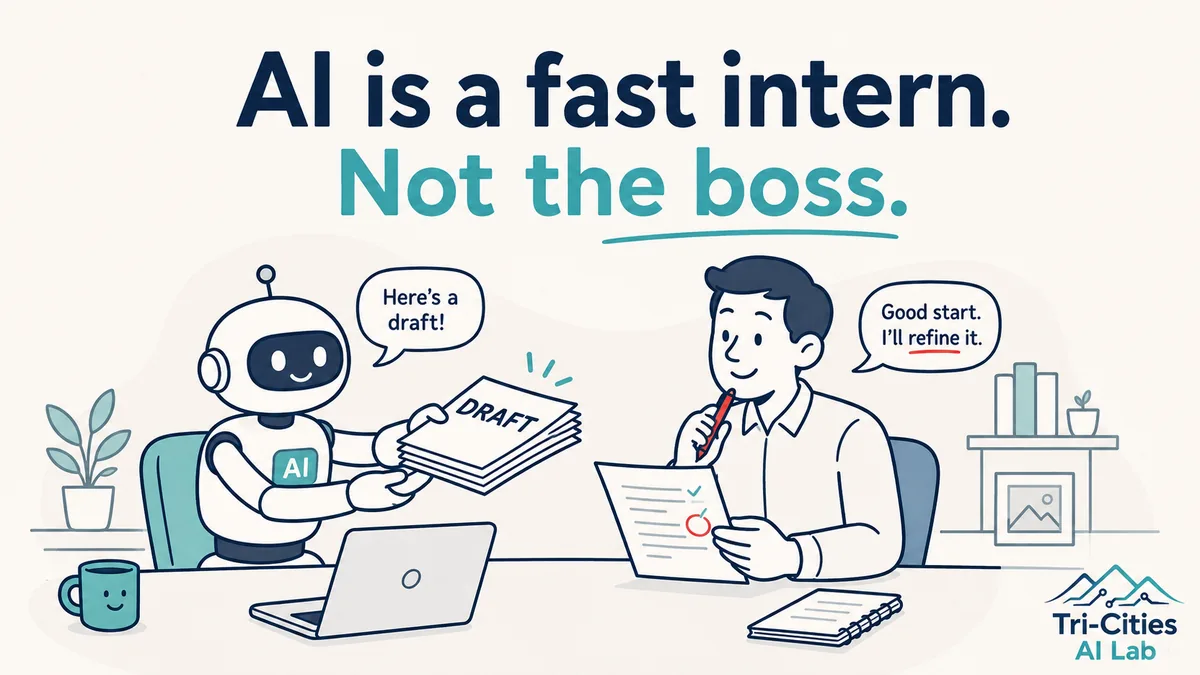
Think of AI as a sharp new intern. If your team needs help building those habits, AI team training is the practical place to start. Drafts fast. Writes well. Eager to help. But you wouldn't let an intern sign a contract, send a customer invoice, or post to your business Facebook page without you reading it first.
Same rule here. Use the speed. Keep the judgment.
Building that judgment into how your business actually uses AI is what an AI Strategy engagement is for. Tell us what is slowing you down.