
- Home
- AI Without the Slop
AI without the slop.
Use AI to save time without publishing generic content, trusting invented facts, or making your business sound like everyone else.
Five questions. About one minute. No email required.
Is your business using AI… or making slop?
This quick assessment is a practical starting point, not a legal, security, or compliance audit.
The issue is not whether you use AI. It is whether the process around it is strong enough to trust.
Good AI use has context going in, qualified review before anything important goes out, and a human being accountable for the result. The quiz measures those habits, not which AI product your business uses.
What "slop" means, and why it matters.
Slop is not merely bad writing. It is AI output that looks finished before anyone has asked whether it is useful, specific, accurate, or accountable.
It could belong to any business, in any industry, in any city.
It sounds correct, but nobody verified the facts, assumptions, or omissions.
It is missing the customers, constraints, numbers, history, and judgment only your team knows.
It went out because the tool produced it, not because a qualified person approved it.
The fix is not less AI. It is better AI habits.
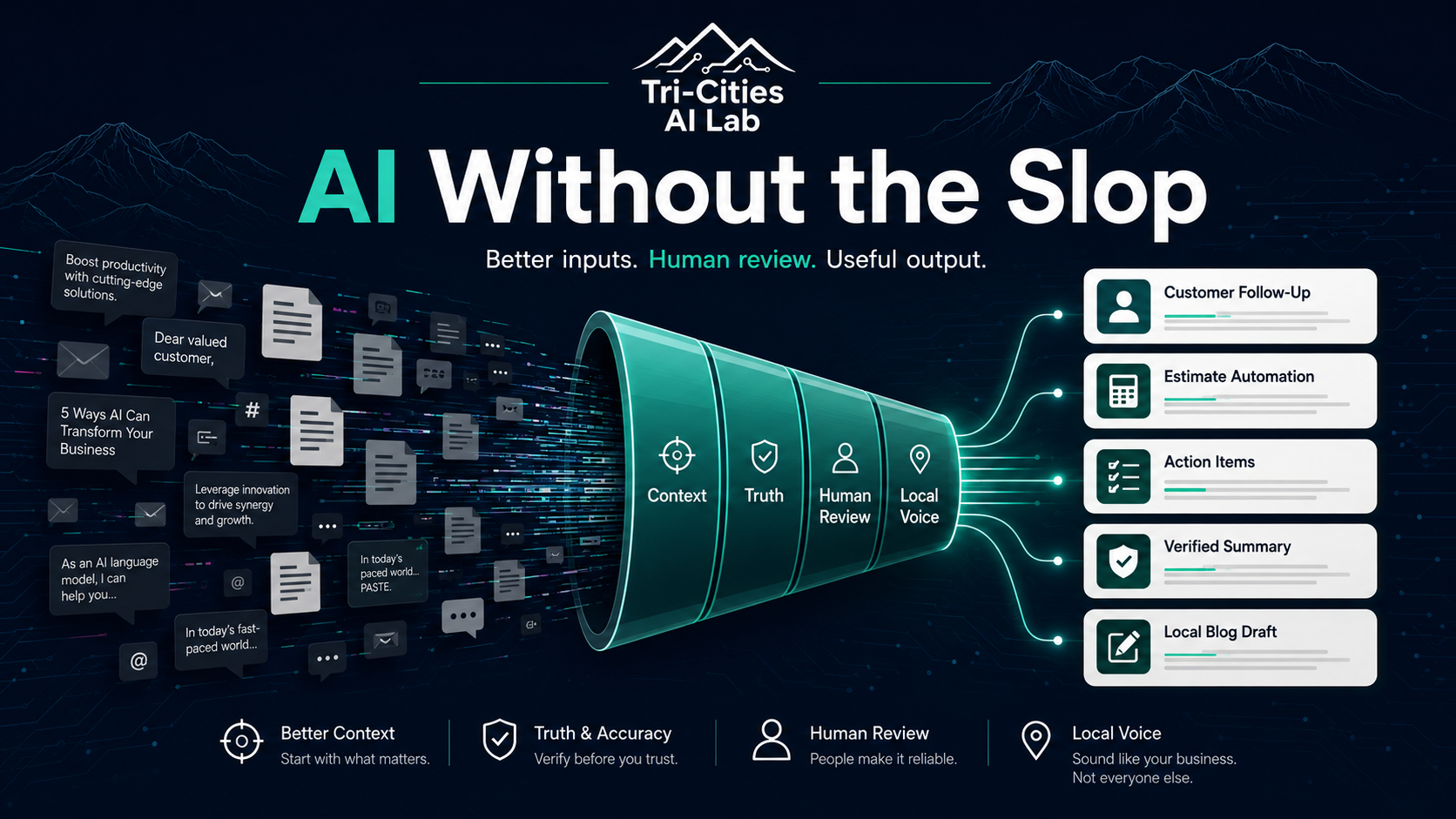
Click to enlarge
Four habits that separate useful AI from slop.
Context before prompting
Give AI the real customer, situation, objective, constraints, and voice.
Truth before polish
Review facts, specificity, assumptions, omissions, and whether the output reflects what actually happened.
Drafts before decisions
Use AI to assist research, drafting, sorting, or summarizing. Keep a qualified person responsible for consequential decisions.
Add what only you know
Include the actual numbers, names, customer history, local context, opinions, exceptions, and recent events.
What good AI use actually looks like.
A generic "five ways AI can help your business" article that could have been published by anyone, about any industry, in any city.
"What happened when we automated our estimate follow-up": specific, first-person, tied to real work, and written in the business owner's actual voice.
A polished but generic email that sounds like every other company and does not reflect the customer's situation.
An AI-assisted first draft edited to include the customer's name, project details, next step, and a real human sign-off.
A meeting summary that records what people said but misses what was decided and what happens next.
A transcript turned into a human-reviewed action list with decisions, owners, and deadlines.
Better output usually starts with better context.
About AI without the slop.
What is AI slop and how does it affect businesses?
AI slop is content or output that is technically functional but lacks specificity, accuracy, or genuine human perspective. It spreads because AI tools make it easy to produce volume without quality. It hurts businesses by making them indistinguishable from competitors using the same tools the same way, in content, customer communications, and internal processes. The fix isn't less AI, it's using AI with real context, editing for truth rather than grammar, and adding information only your business knows.
How can small businesses in Kingsport or Johnson City use AI without producing generic content?
By treating AI as a drafting assistant rather than a publisher. Provide specific context: your actual customer, your actual constraint, your actual tone. Edit for accuracy and voice, not just grammar. Add information AI cannot know: your actual customers, your real numbers, your genuine opinion. The output should sound like you wrote it because, in the ways that matter, you did.
Is AI useful for local businesses in Northeast Tennessee, or is it just for big companies?
AI is often more valuable for small businesses than large ones because the time savings matter more at that scale. A five-hour-per-week recovery for a three-person team in Kingsport or Johnson City is significant, similar to adding part-time help without the overhead. The key is applying it to the right problems with the right oversight, not treating it as a plug-and-play replacement for human judgment.
Useful AI starts with your actual business.
Your customers, staff, policies, exceptions, and judgment are what keep AI output from becoming generic. Tri-Cities AI Lab builds practical workflows around those realities, not around a demo that only works on the happy path.
What we help with
- Finding tasks where AI can genuinely save time
- Documenting review and approval steps
- Building prompts around real business context
- Creating tools that fit existing workflows
- Training teams to verify rather than blindly trust output
Built for businesses in Kingsport, Johnson City, Bristol, and the surrounding Tri-Cities region. Around here, people can spot fake pretty fast. Your technology should make the work better without making the business feel less human.
Built by a local technologist with more than 20 years across web development, digital operations, automation, and applied AI workflows. About Dustin →
Bring us the workflow that feels too messy to automate.
We will help you separate the parts AI can accelerate from the parts that still require experience, judgment, and human accountability.
Want to talk it through?
Call, text, or pick a time. The first conversation is free.
Text (423) 967-5584Please don't send confidential, medical, or financial details by text or form.