

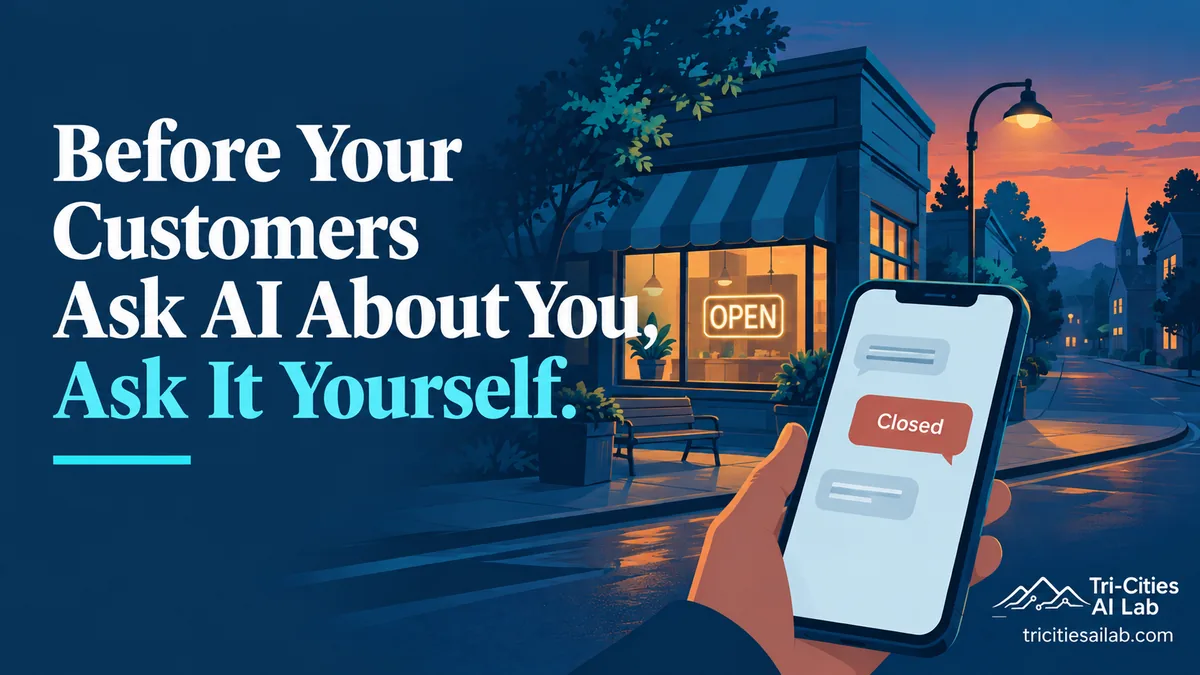
Ask an AI assistant whether your business is open on Saturday. Ask what you charge to come take a look, and whether you serve the next town over. Then compare its answers to what's actually true.
Nearly half of local business owners have never done that. Their customers do it every day.
Two surveys, one gap
This month, BrightLocal published a survey of 1,002 owners of U.S. businesses with 1 to 50 employees. 54% said they had checked and were confident their business shows up in AI results. Another 21% figured it probably does but hadn't looked. Add the owners who simply don't know, and 46% haven't checked at all. In the same survey, 65% said they were actively working on AI visibility.
Now the customer side. SOCi's 2026 Local Discovery Index, a survey of more than 1,000 U.S. consumers, found that 52% used an AI tool to find a local business in the last 30 days, up from 9% a year earlier. Among those AI users, 67% said they'd been given wrong information about a local business at least once, and 30% said it caused them a real inconvenience.
So one group is fairly sure things are fine, and the other keeps getting sent to the wrong address. Both can be true at the same time, which is the whole problem.
A fair warning on the sources. Both companies sell AI visibility software, so read their numbers as direction, not gospel. The pattern they describe shows up in the news, though, and with real names attached.
What "wrong" looks like
These aren't hypotheticals. Here are three businesses that made the news this past year because an AI answer got them wrong.
| Business | What the AI said | What happened next |
|---|---|---|
| Stefanina's, a family pizzeria in Wentzville, Missouri (Aug. 2025) | Google's AI Overview advertised specials the restaurant had never offered, including a second pizza for $4. | Customers called asking for the deals. The family posted on Facebook asking people not to rely on AI and said it couldn't honor Google's specials. (WSB-TV) |
| The Viridian Bookshop in Willoughby, Ohio (July 2026) | Google's AI summary said the store was permanently closed and listed an address a few doors down. | A customer told the owner she'd skipped a visit because of it. The owner reported the error repeatedly, and it was still wrong the day the story ran. (Spectrum News 1) |
| Anna Mae's Bakery & Restaurant in Millbank, Ontario (July 2026) | Google's AI Overview said the bakery would close on July 31. It had mixed it up with an Illinois bakery of the same name that really was closing. | Customers emailed, called, and walked in to ask whether it was true. (MediaPost, via CBC) |
None of these owners did anything wrong. The AI filled in the blanks on its own, and it filled them in with total confidence. Somewhere in Missouri, the best pizza deal in town was one nobody was offering.
What we already know about the Tri-Cities
Credit where it's due. In June, Johnson City's 1-FIND Services published a local study that asked the first half of this question. They ran 405 searches across ChatGPT, Perplexity, and Google for HVAC, plumbing, electrical, roofing, and tree service in Johnson City, Kingsport, and Bristol, then checked which of 68 local businesses got named.
Here's what their 2026 Tri-Cities AI Search Visibility Study found.
- 39 of the 68 businesses were named at least once by ChatGPT or Perplexity.
- Named businesses averaged 352 Google reviews. The ones left out averaged 73.
- Businesses with schema markup were named 57% of the time, and businesses without it 58%. In other words, no difference.
- Google showed no AI Overviews in any of their 135 searches.
- Some of the Bristol answers described Bristol, England, which is a long way to send a plumber.
That study answers who AI names around here. This post picks up the next question. Once AI does name you, what can it actually tell your customer?
Knowing you isn't the same as getting you right
Insites, a company that sells AI visibility audits to agencies, publishes a monthly benchmark. Its September edition covered 8,347 local businesses across seven AI assistants. The headline is the gap between being known and being recommended. ChatGPT recognized a business by name 95.8% of the time. When a customer described the job instead and asked for a recommendation, it named that same business 28.7% of the time. Every assistant they tested showed the same pattern.
Getting named is only half of it. The details have to be right too. Where a business publishes its phone number, the same benchmark found AI gave the right one only 51.9% of the time. Overall, 95.6% of the businesses had their name, website, or phone number wrong in at least one assistant's answer. Insites says the usual culprit is an old listing or directory the AI is still reading from.
A wrong phone number doesn't come with a complaint attached. The customer just calls the next name on the list, and you never find out they tried.
Check your own homepage
You can't control everything an AI reads about you. You can control your homepage, so that's what this checks. Enter your website, pick the kind of question a customer actually asks before calling, and it shows you what an AI assistant could tell that customer using only what's on your page. It also checks whether your site is quietly turning AI search crawlers away, and it gives you the one fix worth making this week.
Check what an AI can tell your customers
This is a simulation from your homepage only. Real AI tools also read reviews, listings, and other sites, and their answers vary.
Want a second set of eyes on it? Text Dustin at (423) 967-5584 or book 15 minutes.
Two honest notes. This is a simulation built from your homepage alone, not a prediction of what ChatGPT will say. Real AI tools also read your reviews and listings, and their answers change from one day to the next. And yes, an AI lab finally put up a tool that uses AI. It seemed like time.
Why AI gets local businesses wrong
Most of what goes wrong falls into four buckets.
1. A bouncer you didn't hire
AI companies send out different crawlers for different jobs. OpenAI, for example, uses GPTBot to collect material for training its models and a separate crawler, OAI-SearchBot, for ChatGPT search. Blocking GPTBot is a reasonable choice. Blocking OAI-SearchBot means your site won't show up in ChatGPT's search answers.
The catch is that a lot of blocking happens without the owner knowing. A tool called WhatToFixFirst tested 904 heavily visited sites and found that more than a quarter block at least one crawler that cites pages in AI answers, more often through a firewall or security setting than through the site's own rules. Google's own guidance says crawling should be allowed both in your site's rules and by any CDN or hosting setup in front of it. That's the firewall check in the tool above.
2. Brochure talk
"Quality service since 1998" is a fine sentiment, and an AI can't do anything with it. It needs the plain facts. Which towns you serve, what you do, when you're open, and what a first visit costs. If your homepage doesn't say it, the AI goes looking somewhere else, and that's how a bakery in Ontario ends up closing on behalf of a bakery in Illinois.
3. Facts stuck in pictures and PDFs
Your hours on a sign photo, your menu as a scanned PDF, your service area drawn on a map image. A person can read those. Google's guidance specifically says to make sure important content is available in text.
4. Old listings that disagree with you
If a directory still has the phone number from two moves ago, AI might use it. Your Google Business Profile matters here more than any trick, and Google lists keeping it up to date among its best practices for appearing in its AI features.
What you can skip
There's a growing industry selling "AI visibility," and some of it is worth a second look before you pay for it.
- Special AI markup. Google says structured data isn't required for its AI features and there's no special markup to add. It's still useful for regular search results. And when Ahrefs tracked 1,885 pages that added it, AI citations didn't go up on any platform they measured.
- An llms.txt file. Google says its search ignores these files. They won't hurt, but they won't help with Google either.
- New acronyms. Google's own guide says that optimizing for its AI search is still just SEO. The industry has invented at least three new names for "keep your information correct and easy to find."
It's also worth hearing from the skeptics. Search consultant Marie Haynes looked at a year of analytics across 100 websites and found that ChatGPT sent about 0.62% as many visits as Google's regular results. For local businesses, though, that measures the wrong thing. A customer who asks AI who's open Saturday and then just calls you never shows up as a website visit. That's why getting the answer right matters more than counting clicks.
The 15-minute fix
If you only do one thing, add a short block of plain facts to your homepage, written the way a customer would ask. Here's an example for a made-up plumbing company.
Ridgeview Plumbing serves Kingsport, Johnson City, Bristol, Blountville, and Gray.
We repair leaks, replace water heaters, clear drains, and handle remodel plumbing for homes and small businesses.
Open Monday through Friday, 7 a.m. to 6 p.m., and Saturday mornings. Emergency calls answered 24/7.
Service calls start at $89, and that fee comes off the bill if you hire us for the job. Call (423) 555-0100.
Then work through the rest of the list.
- Run the check above and fix whatever it flags first.
- Open your Google Business Profile and confirm the hours, phone, website, and services match your homepage.
- Ask a customer's question yourself in two different AI tools, and ask it more than once, because the answers change.
- If you use Google Search Console, make sure your site is included in Google's generative AI features. Google requires that setting for AI Overviews and AI Mode, and it can be switched off.
- Keep asking for reviews that mention the job. "Fixed our water heater the same day" helps more than five stars and nothing else. Reviews were the strongest signal in both the 1-FIND and Insites data.
AI is going to answer questions about your business whether you check on it or not. You might as well give it the right answers to work with.
If the check turns up something you'd rather not untangle yourself, send me a text or book 15 minutes. Every message is read by me, not a bot.
Sources
- BrightLocal, "65% of small businesses are working on AI visibility," Small Business Marketing Report 2026, Chapter 3, Oct. 21, 2026. Link
- SOCi, "AI Usage Surges 6X for Local Search, Fragmenting the Digital Ecosystem," 2026 Local Discovery Index, Sept. 24, 2026. Link
- Insites, Local AEO Benchmark, September 2026 (published Sept. 23, 2026). Link
- 1-FIND Services, "2026 Tri-Cities AI Search Visibility Study," June 2026. Link
- WSB-TV / KMOV, "Restaurant is fighting fake deals generated by Google AI," Aug. 21, 2025. Link
- Spectrum News 1, "Ohio business says inaccurate Google AI summary of store is hurting sales," July 23, 2026. Link
- MediaPost, "Bakery Owner Panicked After AI Overview Hung A Closing Sign," July 27, 2026, citing CBC News. Link
- OpenAI, "Overview of OpenAI Crawlers." Link
- WhatToFixFirst, "Which hosts and firewalls block AI crawlers by default," Sept. 8, 2026. Link
- Google Search Central, "AI features and your website." Link
- Google Search Central, "Optimizing your website for generative AI features on Google Search." Link
- Ahrefs, "We Tracked 1,885 Pages Adding Schema. AI Citations Barely Moved," May 11, 2026. Link
- Marie Haynes, "GEO is a distraction," Oct. 21, 2026. Link