

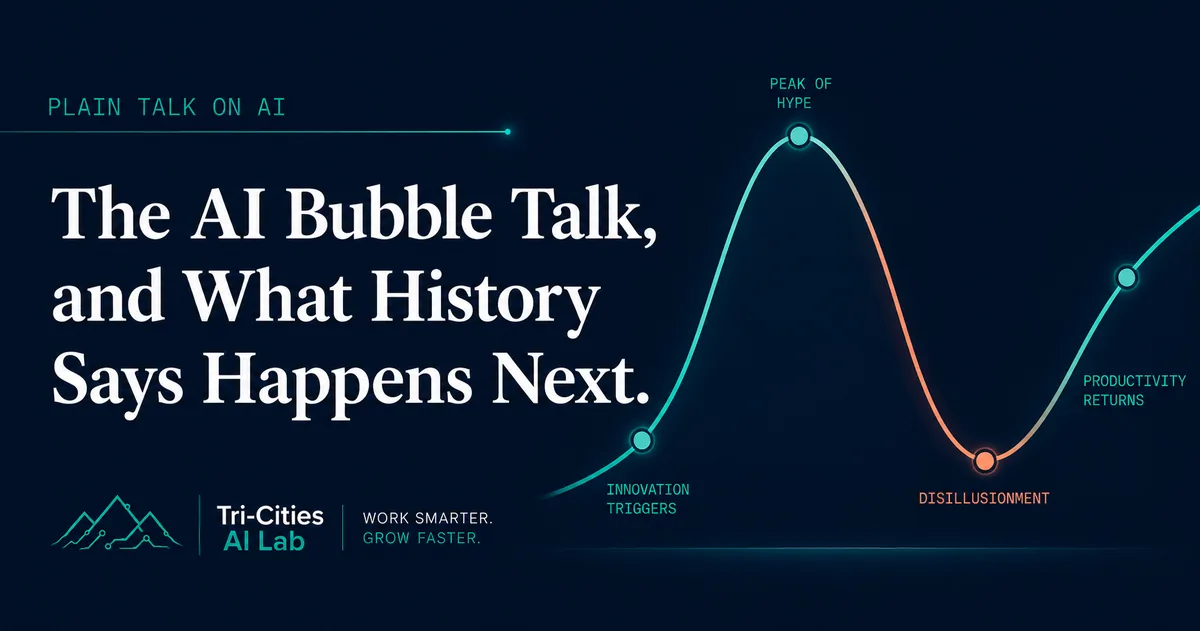
Everywhere you look, someone is predicting the AI bubble will burst and take the whole thing down with it. Here is the calmer version, with the numbers checked and the history laid side by side.
Open any feed right now and you will find someone cheering for the AI bubble to pop. The money is fake, the story goes. The tools are useless. Prices are about to climb so high that regular people get locked out. And the whole thing is going to collapse any day now.
Some of that is worth taking seriously. A lot of it is two completely different arguments wearing the same coat. So before you decide whether to worry, it helps to separate what people are actually saying.
There are two arguments, not one
When people say "AI bubble," they usually mean one of two things, and they are not the same.
The first is a money question: are investors paying too much, too soon, for companies and data centers that have not yet earned it back? That is a real and fair question. The second is a usefulness question: is the technology any good, and why does it feel like everyone hates it? That is also fair, but it has almost nothing to do with the first one.
A stock can be overpriced while the product underneath it is excellent. That happened the last time around, and it is the single most useful thing to understand about this moment.
The last bubble was real. The internet was not the problem.
In the late 1990s, money poured into anything with ".com" in the name. The tech-heavy Nasdaq index climbed for years, peaked on March 10, 2000, then fell roughly 78% over the next two and a half years. Trillions in paper wealth vanished. By any honest definition, that was a bubble, and it burst.
The Dot-Com Round Trip
The Nasdaq peaked in March 2000, fell about 78%, and did not reclaim that high until 2015. The internet, meanwhile, never stopped growing.
Source: Nasdaq Composite closing levels. Peak 5,048.62 (Mar 10, 2000); low 1,114.11 (Oct 9, 2002); recovery 2015. Line is illustrative, not every data point.
Here is the part that matters. The companies that were mostly hot air died fast. Pets.com, Webvan, and dozens of others burned through their cash and closed. But the companies with something real underneath them, like Amazon, eBay, and a young Google, came out the other side and grew into giants. Amazon's stock fell about 90% in the crash. It did not go anywhere.
And the internet itself? It never slowed down. The number of people online kept climbing straight through the crash and never looked back. The bubble was in the stock prices, not in the technology.
The "wasted" infrastructure that quietly powered the next decade
There is one more piece of dot-com history that maps almost perfectly onto today, and it is the one most people forget.
During the boom, telecom companies laid an enormous amount of fiber-optic cable across the country, far more than anyone needed at the time. When the crash came, most of that cable sat unused for years. People in the industry called it "dark fiber." It looked like a colossal waste of money, and for the investors who paid for it, it was.
But the cable did not disappear. It sat in the ground, cheap and waiting. And when streaming video, smartphones, and cloud computing arrived a few years later, that "wasted" infrastructure became the backbone that carried all of it. The overbuild that ruined investors became a gift to everyone who came next.
Today the equivalent is data centers, chips, and power. If there is an overbuild, and there may well be, the lesson from fiber is that the buildings and the power lines do not evaporate when stock prices fall. They get cheaper, and someone uses them.
So is this 1999 all over again? Yes and no.
The rhyme is real. Lots of money, lots of hype, a handful of stocks carrying the whole market, and a building boom running ahead of proven demand. Anyone telling you there is zero bubble risk is selling something.
But one difference is big enough to change the story: in 1999, the darlings mostly had no revenue. Today's leaders do, and a lot of it.
That does not prove the prices are reasonable. Plenty of smart people argue the spending is still running way ahead of the income, and they have a point worth hearing. But "these companies have no business model" was true in 1999 and is not true now. That is a different starting place.
Here is the honest version of both sides, without the cheerleading:
▼ The case for worry
Spending on AI data centers is enormous and partly funded by debt. Some of the biggest deals are circular: chipmakers invest in AI labs that turn around and buy their chips. And surveys keep finding most company AI projects never make it past the pilot stage. If the income does not catch up to the spending, prices could fall hard.
▲ The case for calm
The leading tools have real, fast-growing revenue and hundreds of millions of users. The cost of running AI has dropped sharply, not risen. And the companies doing most of the building are profitable giants paying out of pocket, not fragile startups living on borrowed time. Even a correction would leave the useful tools standing.
The cost of using AI is falling, not climbing
One of the loudest fears is that AI will get so expensive that regular people and small businesses get priced out. It is worth looking at what has actually happened to cost, because it runs the other direction.
The cost of running a capable AI model has dropped dramatically, year after year, as the hardware improves and competition heats up. By most credible measures it has fallen roughly tenfold per year for a given level of capability. Open-source models you can run cheaply keep getting better, which puts a ceiling on what anyone can charge for the routine stuff.
What It Costs to Run a Capable Model
The price to run a model at a given quality level has fallen steeply. This is the trend that argues against the "AI will get unaffordable" fear, at least for everyday use.
Source: Stanford HAI AI Index 2025, for a model at GPT-3.5 quality. A roughly 280-fold drop in under two years.
There is a real catch, and it is fair to name it. A lot of today's consumer pricing has been kept artificially low while companies chase growth. That is starting to change. In June 2026, GitHub moved its popular Copilot coding tool from a flat monthly fee to charging based on how much you use, and heavy users saw their bills jump. Expect more of that.
But "the all-you-can-eat deals are ending" is not the same as "AI is becoming unaffordable." The more likely outcome is that light, everyday use stays cheap or free, while the heaviest power users pay for what they actually consume. That is how cloud storage, electricity, and most utilities already work.
Why so many people say they hate AI
Now the second argument, the one that has nothing to do with stock prices.
A lot of the anger at AI is not really about the technology. It is about how it was sold. Company after company rushed a product out the door, promised it would do everything, delivered something half-baked, and never bothered to show people how to actually use it well. When a tool is oversold and under-explained, people are right to be frustrated. The tool gets the blame, but the rollout earned it.
I have watched this up close. Having spent years in and around the media business, I have heard plenty of colleagues say AI is garbage and that it could never do their job. And here is the thing: replacing them was never the point. Used as a tool, in the hands of someone who knows the work, it is genuinely useful. It drafts, it summarizes, it handles the tedious parts so the skilled parts get more attention. Used as a replacement for thinking, it disappoints, and people notice.
The hate is mostly aimed at the bad rollouts and the broken promises. That is a fixable problem. It just is not the technology's fault.
What I think actually happens
I am not going to predict a crash date. Anyone who tells you exactly when a market turns is guessing, and the honest read on the money flowing into AI right now is that a sudden pop does not look imminent. There is too much capital still moving in.
But whether a correction comes next year or in five years, the dot-com pattern is the one to keep in mind. When the froth clears, the rushed and oversold products, the ones that made people hate AI in the first place, will quietly die off. And the genuinely useful tools, the ones built around real work instead of hype, will still be standing. They will keep getting better and cheaper, the same way the internet did after 2002.
A market correction would not kill AI. It would clear out the rushed, oversold products and leave the tools that actually save you time. The smart move is not to wait for the bubble. It is to learn which tools earn their keep now, so you are already using the survivors.
If you run a small business in our area and you are tired of the hype in both directions, that is the practical version: ignore the doomsayers and the cheerleaders, pick one or two tools that solve a real problem in your day, and learn to use them well. That is the part nobody can take away from you, bubble or no bubble.
Figuring out which one or two tools actually fit your business is what an AI Strategy conversation is for. Tell us what is slowing you down.