

Most small business owners I talk to in the Tri-Cities are not short on ideas. They are short on time. The receptionist is also the bookkeeper. The owner is doing three jobs before lunch. The real promise of AI here is not some far-off robot future. It is simpler than that: hand the boring, repetitive work to software so the people in your business can spend their hours on the work that actually needs a person.
That is the whole idea of this post. Not replacing your team. Not "transforming" your business overnight. Just taking the dull, time-eating tasks off everyone's plate so the time goes back into bigger and better things. And the encouraging part is that this is no longer theoretical. There is now a working example running right here in Kingsport.
Sources: SBE Council (2026), NFIB (2025), U.S. Chamber of Commerce (2025). See full citations below.
What "AI automation" actually means for a small business
Forget the science fiction version. For a small business in 2026, AI automation usually means using everyday software to draft, sort, summarize, schedule, or follow up so a person spends less time on routine admin. The U.S. Small Business Administration lists the same practical examples: sorting email, sending reminders, summarizing meetings, drafting posts, writing product descriptions, and answering common customer questions (SBA).
It helps to think of three levels:
- AI assists a person. It drafts or organizes the work, a human approves it.
- Semi-automated workflow. AI plus simple rules sends reminders or routes messages, with spot checks.
- Unattended action. The system acts on its own with no review.
For almost every small business, the safe and useful zone is the first two levels. The third one is where the trouble lives, and we will get to why. The good news is that the first two levels are exactly where the time savings are, and you do not need a developer or a big budget to reach them.
Kingsport's Grace AI: a real local example
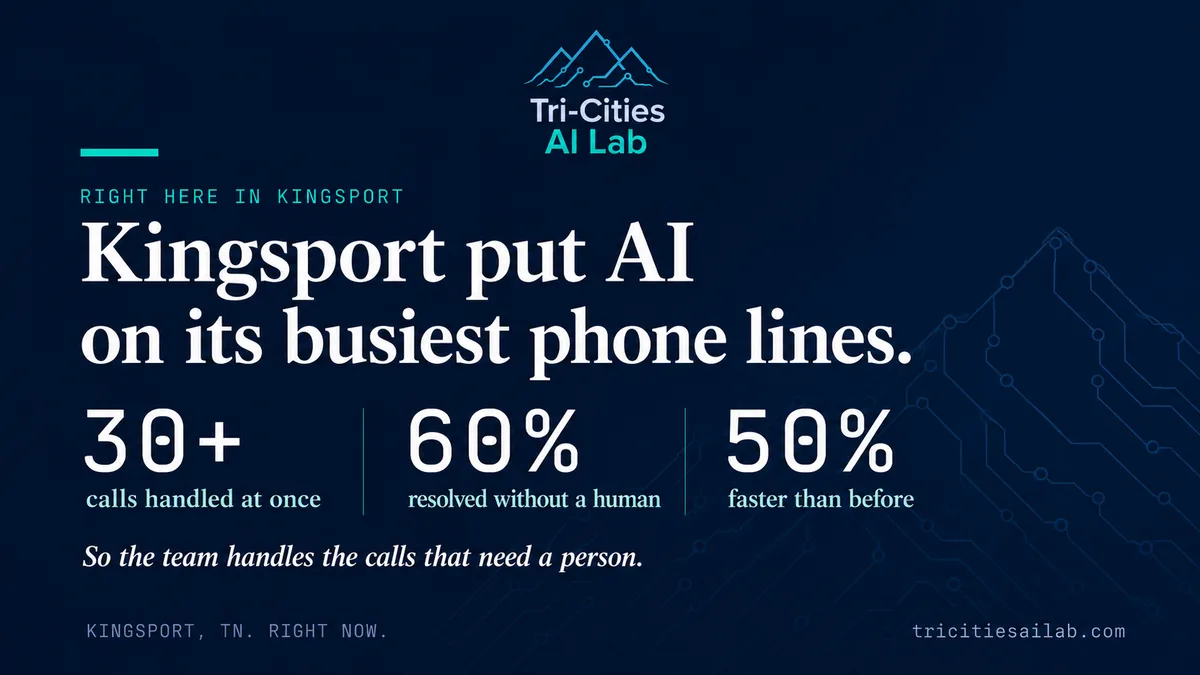
In late April 2026, the City of Kingsport put an AI agent named Grace to work on its water utility phone lines. Grace AI handles the routine calls a lean customer service team gets all day: balances, due dates, payments, and payment plans, in English or Spanish. In its first few weeks, Grace was handling more than 30 calls at once, resolving over 60% of them start to finish without a human, and working roughly 50% faster than a human agent.
Here is the part that matters for this post. The city's own CIO described Grace as a way to let the human team focus on the more complex calls, the ones that actually need a person's judgment and patience. The routine "what's my balance" calls get handled instantly, and the staff get their time back for the harder, more human work. That is the entire thesis of practical AI in one local example. Kingsport is a city government, not a corner shop, but the principle scales straight down to a five-person business.
Why you hear wildly different numbers about AI adoption
If you have seen one headline say "only 9% of small firms use AI" and another say "nearly 60% do," you are not losing your mind. They are measuring different things. The number depends entirely on how the survey defines "use."
Same question, different definitions
Share of businesses "using AI" depends on how narrowly the survey asks.
Narrowest: AI used in producing goods or services, small firms (Census/SBA). Broadest: any use of generative AI (U.S. Chamber). The Federal Reserve figure covers all U.S. firms; NFIB covers small employers using AI for any business activity. All four are accurate. They just ask different questions.
The honest takeaway: ask narrowly and AI use looks small, ask broadly and it is most businesses. The Tri-Cities sits squarely in the national picture, and the Chamber found a majority of small businesses in all 50 states now using AI in some form. The direction is not in doubt. The only real question for you is which boring task to hand off first.
The boring stuff worth handing off first
The best first candidates are repetitive, text-heavy, and low-risk. Here is where local businesses are actually getting time back, with examples you will recognize from around here:
Skilled trades, HVAC, plumbing, electrical, flooring
Turn missed calls, texts, and website leads into a clean daily list. Draft an estimate from a technician's voice notes. Send appointment reminders and follow-up review requests automatically. The tech still confirms the final price and scope. Around here, where the trades are short-handed, that means less time on the phone and more billable hours in the field.
Restaurants and food service
Draft daily specials and social posts, reply to common reservation and catering questions, and build low-stock alerts from your sales data. For a downtown Bristol spot, that can mean planning ahead for a race weekend at the Speedway instead of scrambling when the crowd shows up.
Salons and personal services
Automate appointment reminders and no-show follow-ups, and draft polite responses to those late-night Instagram messages asking about pricing and availability, with a booking link attached. The owner stops losing personal time to a chaotic inbox between clients.
Healthcare and dental practices
Use HIPAA-aware tools to draft visit notes from a provider's spoken summary and to handle appointment reminders. Given how much of our regional economy runs on healthcare, cutting the charting burden is one of the clearest time-back wins, as long as the privacy side is handled correctly.
Professional services, law, accounting, real estate
Summarize a long document to find the sections that matter, draft a first-pass listing description from a few bullet points, or sort routine client email before a person replies. A Dallas law firm put it well to CNBC: AI freed up associates from grunt work, which meant senior partners had more time to mentor. That is the pattern. The boring work shrinks, the valuable work grows.
This is about boring work, not your people
I want to be straight with you, because the job-loss fear around AI is real and I am not going to talk around it. Here is what the data actually shows for small businesses, and it is not what the scary headlines suggest.
AI is adding to small teams, not shrinking them
Across independent, association, and program surveys, the story is the same.
NFIB found 98% of small employers using AI saw no change in employee count. Goldman Sachs found 87% of small business AI users say it augments rather than replaces staff. The U.S. Chamber found 82% of small businesses using AI grew their workforce over the prior year. Three different organizations, same direction.
That tracks with what most owners here already know in their gut. Nobody around here is sitting on extra staff they are itching to cut. They are stretched thin. When the routine work gets automated, the receptionist is not out of a job. She finally gets to stop drowning, and the business gets to grow into the time that opens up.
I will say the hard part plainly, because pretending otherwise would insult you: automation can be used to cut staff. That is a choice an owner makes, not something the tool decides. The businesses that win with this do not use it to shrink. They use it to do more with the good people they already have. The time you get back is the whole point. What you do with it is up to you.
If a task is repetitive, text-heavy, and low-risk, AI is probably ready to help today. If it touches money, contracts, legal exposure, private records, or a sensitive customer relationship, let AI draft or flag it and let a person decide.
Where a human still has to look
Here is the catch, and it is a real one. These tools sometimes make things up. The polite term is "hallucination," and it means the software can produce a confident, plausible answer that is simply wrong. That is exactly why the "AI drafts, a person approves" rule is not optional for anything a customer sees.
The cautionary tales are easy to find. An airline was held responsible after its website chatbot gave a customer a refund policy that did not exist. The FTC took action against a company that marketed an AI as a substitute for a lawyer without testing whether it actually performed like one. The lesson for a local business is the same in both cases: do not let an unsupervised tool speak or act for you in situations that carry real consequences.
There is also a quieter risk: sounding like everyone else. Left alone, AI drifts into generic, overly cheerful corporate filler. In a region where people do business with you because they know you, that flat tone can cost you the exact thing that sets you apart. Use it to get a draft on the page, then make it sound like you. Worth noting that even your own staff feel this line. In one 2026 survey, 45% of small business workers worried that leaning too hard on AI could hurt the company's reputation, and 53% preferred to keep operations mostly human-led. That instinct is healthy. Listen to it.
The privacy line that actually matters
You will hear two kinds of advice on free versus paid tools. Here is the version I stand behind, and it is about what you put in, not what you pay. A free tool is perfectly fine for drafting a social post or brainstorming a slogan. The moment you are dealing with client records, patient information, or financial data, you need a paid business tier with the data-training setting turned off, because free consumer tools can use what you type to train their systems by default. A salon captioning a photo is not the same as a dental office pasting in patient notes. Match the tool to the sensitivity of the work.
What it costs to start
The barrier to entry is low, which is the genuinely good news. You do not need servers or a developer. Most businesses start with a subscription or two:
- A general AI assistant: free to try, about $20/month for the paid tier.
- A no-code connector like Zapier to link your apps: from about $20/month.
- A meeting-notes tool: from roughly $8 to $17/month.
A realistic starter stack runs somewhere between $20 and $60 a month. Set against the cost of even one hour of staff time, that math works quickly. The smart move is to automate one narrow task, watch it for a few weeks, and only then trust it with more. Automating a messy process just lets you make mistakes faster, so start small and get one thing right.
AI's real value for a Tri-Cities business is not replacing people. It is removing the repetitive admin work that eats your week, so your time goes back into the work that grows the business. Pick one boring task, let AI draft it, keep a person in the loop, and start getting your hours back.
Not sure which boring task to hand off first?
That is exactly the conversation I have with local business owners. No jargon, no pressure, just a straight look at where you would get the most time back.
Tell us what is slowing you downGrace AI in Kingsport: quick answers
What is Grace AI in Kingsport?
Grace AI is an AI-powered virtual call center agent the City of Kingsport launched on its water utility in late April 2026. It is built on Hansen Technologies' AI agent platform and connected to the city's customer system, so it can answer account questions and take action over the phone, in English or Spanish.
What does Grace AI do for Kingsport residents?
Grace handles routine water and utility calls: checking a balance, due dates, and water usage, taking payments, and setting up payment plans. It is reachable by phone, and the city has also offered web, text, and email contact through its new customer system.
How well is Grace AI working so far?
In its first few weeks, the city reported Grace was handling more than 30 calls at once, resolving over 60% of them without a human, and working about 50% faster than a human agent. The point was not to cut staff but to let the human team focus on the more complex calls.
What does Grace AI mean for small businesses in the Tri-Cities?
It is a local proof of the same idea any small business can use: let AI handle the high-volume routine work so people spend their time on the work that actually needs a person. Kingsport is a city government, but the pattern scales straight down to a five-person business.
Sources
- City of Kingsport / Hansen Technologies, "City of Kingsport Sees Immediate Impact with Hansen AI Call Center Agent," PR Newswire, May 19, 2026. Link
- U.S. Small Business Administration, "Artificial intelligence for your small business." Link
- SBA Office of Advocacy using Census BTOS, "AI in Business: Small Firms Closing In," Sept. 24, 2025 (8.8% narrow small-firm use). Link
- Federal Reserve, "Monitoring AI Adoption in the U.S. Economy," FEDS Notes, Apr. 3, 2026 (~18% of all firms). Link
- NFIB, "Small Business and Technology Survey," June 25, 2025 (24% of small employers use AI; 98% reported no change in employee count; n=521, fielded Mar. 6 to 31, 2025). Link
- U.S. Chamber of Commerce, "Empowering Small Business: The Impact of Technology on U.S. Small Business," Aug. 2025 (58% use generative AI; 82% of AI users grew workforce; majority adoption in all 50 states; n=3,870, fielded June 6 to 26, 2025). Link
- Goldman Sachs 10,000 Small Businesses Voices survey, Mar. 17, 2026 (87% say AI augments rather than replaces staff; n=1,256).
- SBE Council / TechnoMetrica technology survey, Mar. 2026 (median 5 owner-hours per week saved; n=517).
- Business.com with Dialog, "2026 Small Business AI Outlook Report," Jan. 20, 2026 (5.6 hours per week average time saved; 45% worried about reputation, 53% prefer mostly human-led; n=1,009). Link
- CNBC, "Small businesses are using AI," June 24, 2025 (law firm freeing associates from grunt work). Link
Ready to get some of that boring stuff off your plate? See Workflow & Process Automation, or tell us what is slowing you down.