

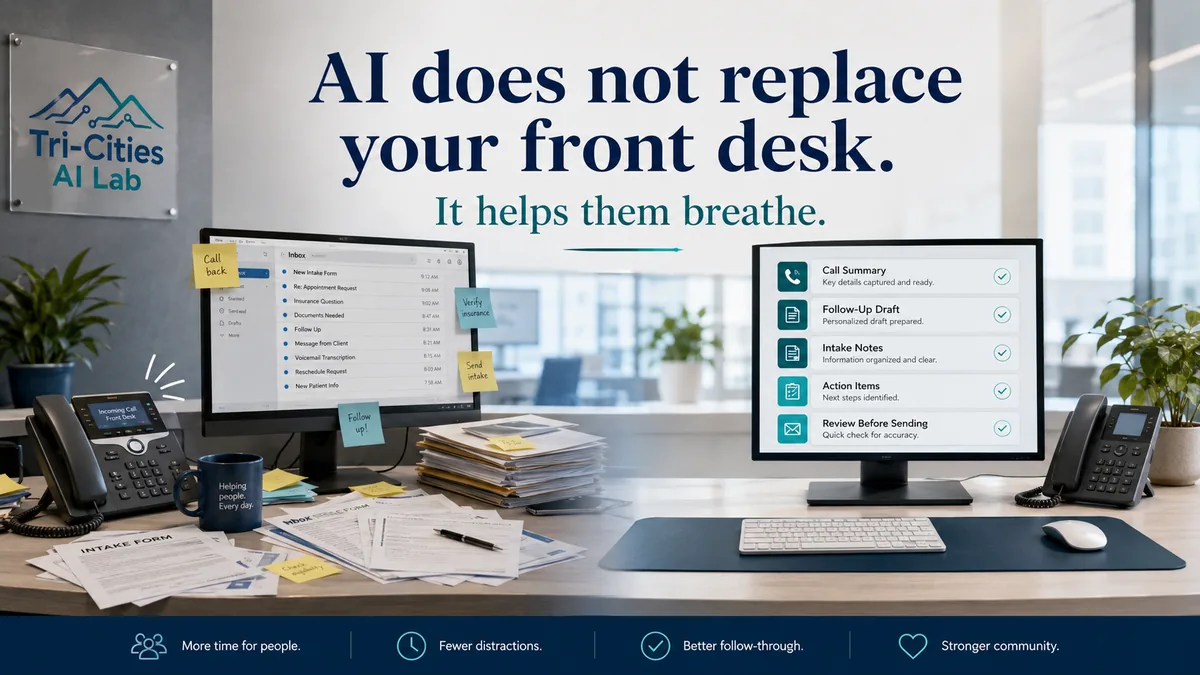
Local Business Use Case: Front desk support
Your front desk is probably doing a lot more than answering the phone.
They are greeting people, scheduling appointments, taking messages, answering the same questions over and over, chasing down paperwork, sorting through emails, handling frustrated customers, and somehow trying to keep the whole day from falling apart before lunch.
That is not a people problem.
That is a workload problem.
And this is one of the places where AI can actually help a local business in a practical way without replacing the person who makes the office work.
The front desk has become the catch-all department
In a lot of small businesses, the front desk is not just one job. It is five or six jobs stacked on top of each other.
One minute they are answering a new customer inquiry. The next minute they are trying to reschedule an appointment, respond to an email, find a missing form, explain a policy, or remind someone internally that a follow-up still needs to happen.
For medical offices, law firms, home service companies, clinics, nonprofits, and small professional offices, this is where a lot of the daily friction lives.
Not because the staff is doing anything wrong. Most of the time, they are doing the best they can with too many moving parts and not enough time.
AI does not have to talk to your customers to be useful
When people hear “AI for the front desk,” they usually picture some cold chatbot trying to replace a real person.
That is not what I mean.
For most local businesses, the better starting point is behind the scenes. Let AI help organize the mess before a human reviews it, edits it, and decides what actually gets sent.
That could look like:
- Turning rough call notes into a clean intake summary
- Summarizing a long voicemail so nothing important gets missed
- Drafting a follow-up email for staff to review
- Pulling action items out of a long email thread
- Creating a checklist from a customer request
- Organizing appointment details before they go into your system
- Helping write polite replies to common questions
The important part is this: the human still stays in control.
AI drafts. Your staff reviews. Your business decides.
AI should not replace the person at your front desk. It should help them stop drowning in repetitive work.
What this looks like in a real local office
Let’s say a local office gets thirty calls and emails before noon.
Some are new customer questions. Some are appointment requests. Some are people asking for the same basic information that has already been explained a hundred times. Some need a form. Some need a callback. Some need to be routed to the right person.
By lunch, the front desk may have a pile of sticky notes, half-written emails, voicemails to return, and several small tasks that are easy to lose track of.
This is where AI can help turn the pile into something more manageable.
Example workflow
New inquiry: AI turns the notes into a clean intake summary.
Missed call: AI drafts a callback note with the key details.
Common question: AI suggests a response based on approved business information.
Long email thread: AI identifies what still needs to be done.
Follow-up needed: AI drafts a message for staff to review before sending.
None of that replaces the front desk.
It just gives the front desk a better system for handling the work that is already coming in.
The real value is fewer dropped balls
The best use of AI in a small business is not always flashy.
Sometimes it is simply making sure fewer things fall through the cracks.
Fewer missed follow-ups.
Fewer unanswered emails.
Fewer forgotten voicemails.
Fewer customers waiting two days for a simple answer.
Fewer employees feeling like they are constantly behind.
That is the kind of AI use case that actually matters to a local business.
This still needs human review
This is also where businesses need to be careful.
AI should not be blindly sending messages, inventing policies, giving legal advice, giving medical advice, or speaking for your business without oversight.
That is how you get AI slop.
The better approach is slower, cleaner, and much more useful:
- Use approved information.
- Keep a human in the review process.
- Do not let AI guess when the answer matters.
- Build simple workflows before chasing complicated automation.
That is the difference between using AI as a gimmick and using it as an actual business tool.
Start with the pressure points
If your front desk, office manager, or admin person is overwhelmed, the first question should not be, “How do we replace this role with AI?”
The better question is:
What repetitive work is making this role harder than it needs to be?
That is usually where the best AI opportunities are hiding.
Not in replacing people.
In helping good people keep up.
At Tri-Cities AI Lab, that is the kind of AI work we care about: practical systems, human review, better workflows, and no AI slop. See Document Intelligence & Search for more, or tell us what is slowing you down if that sounds like what your office needs.