

What happens when you and the shop across town both let AI write your marketing.
Last week I ran a small test. I opened four of the most popular AI tools, ChatGPT, Gemini, Perplexity, and Grok, and gave each one the exact same request, the kind a real coffee shop owner might type: write ten tagline options for a local coffee shop. Fresh chats. No setup, no special instructions, nothing that would nudge them toward the same place.
I expected similar advice. I did not expect them to hand me the same taglines.
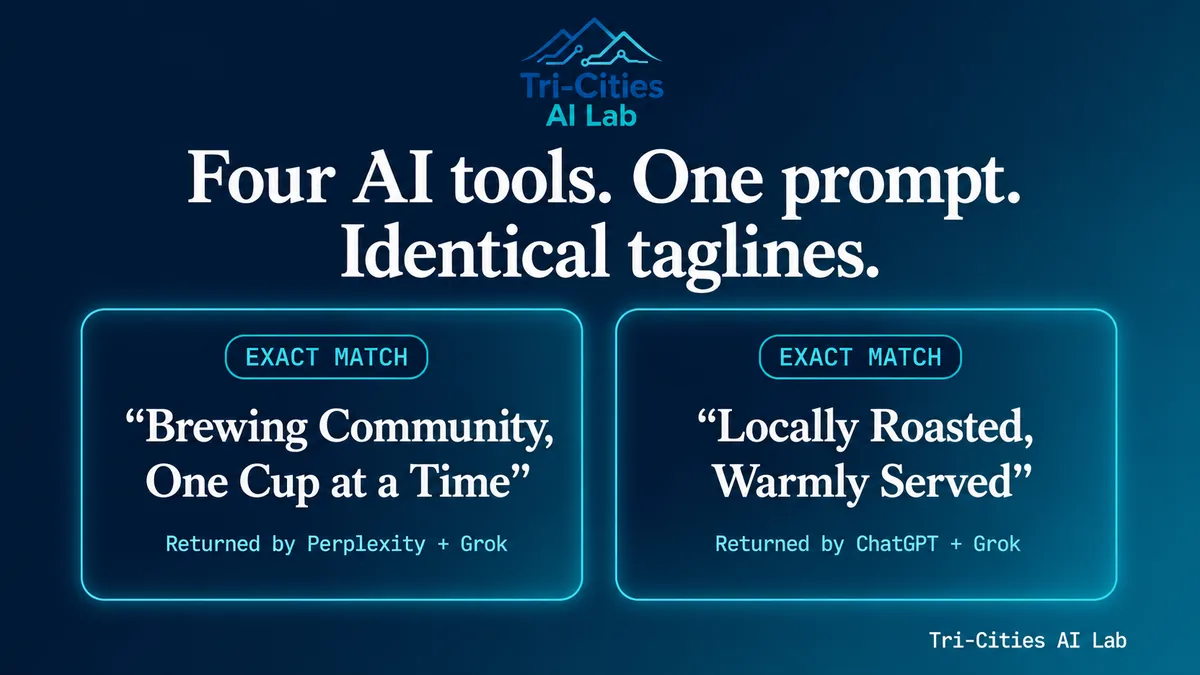
Two of them matched word for word
Not "kind of alike." Identical. Two separate tools, asked independently, produced the exact same line:
The rest were not far behind. Every tool reached for the same handful of ideas, just with the words shuffled:
| The idea they all landed on | How each tool phrased it |
|---|---|
| Good coffee, good neighbors | "Good coffee. Good company." / "Good neighbors, great coffee." / "Good coffee. Better neighbors." / "Good Coffee. Great Neighbors." |
| Small town, big flavor | "Small-town warmth. Big coffee flavor." / "Small town roots, big coffee energy." / "Small batches. Big flavor." / "Small Town. Bold Flavor." |
| Fresh beans, familiar faces | "Fresh brews, friendly faces." / "Fresh beans, familiar faces." / "Fresh Beans. Local Vibes." |
| Where the town gathers | "Where the locals come to refuel." / "Where locals meet, and mornings begin." / "Where the neighborhood wakes up." / "Where Every Sip Feels Like Home." |
Then I tried the bigger questions: brand positioning, social media post ideas, how to stand out from the competition. Same pattern. All four told me to be the town's "third place." All four suggested a "meet the regulars" post, a behind-the-scenes video, and a collaboration with a local business. The advice was fine. It was also interchangeable.
Why this happens
This is not a glitch, and it is not the tools being lazy. It is how they work. AI writing tools learned from a huge pile of the same public material: the same blog posts, the same marketing articles, the same advice that is already all over the internet. When you ask a question, the tool gives you back the most common, safest, most average version of the answer.
Think of it this way: ask ten well-trained people the same textbook question and you tend to get the same textbook answer. They are not copying each other. They just learned from the same sources. AI does the same thing, at scale, in a few seconds. The catch is that your competitor is asking the same tool the same question.
Why it should get your attention
If you use AI to write your website copy, your tagline, and your posts, and the shop across town does the same, you are both pulling from the same well. You start to sound alike. Your "what makes us different" page ends up describing the same business.
This is not just a hunch. Researchers studied independent restaurants in Milan and watched what happened to their social media marketing when ChatGPT was temporarily unavailable. With the tool gone, the restaurants' posts became noticeably more distinct from one another. And here is the part worth underlining: their posts got more likes, not fewer, about 3.5 percent more on average. The generic version had been quietly costing them engagement. (Liu, Wang & Yang, working paper, 2025.)
When everyone sounds the same, sounding like yourself becomes the advantage.
So what do you actually do
None of this means stop using AI. I use it every day, and it genuinely saves time on the boring parts. The point is knowing where to let it stop.
AI is excellent for the first draft, the blank-page problem, the rough shape of a post. It is not good at knowing the things that actually make customers choose you: the regular who has come in every Tuesday for six years, the festival that shuts down Main Street every fall, the one thing you do that nobody else around here does. The tool cannot know those. You can.
So let AI handle the draft, then do the part that makes it yours. Add the local detail. Cut any line that could belong to any business in any town. Keep only what you could have written. That is the difference between copy that was AI-generated and copy that is human-reviewed and built around your actual business.
If your marketing has started to feel a little generic lately, that is usually the sign that AI got the last word instead of the first draft. Helping local businesses use these tools to save time without sounding like a template is a lot of what we do at Tri-Cities AI Lab. The tools are worth using. They just should not be the ones deciding what makes you, you. See AI Strategy, or tell us what is slowing you down.