

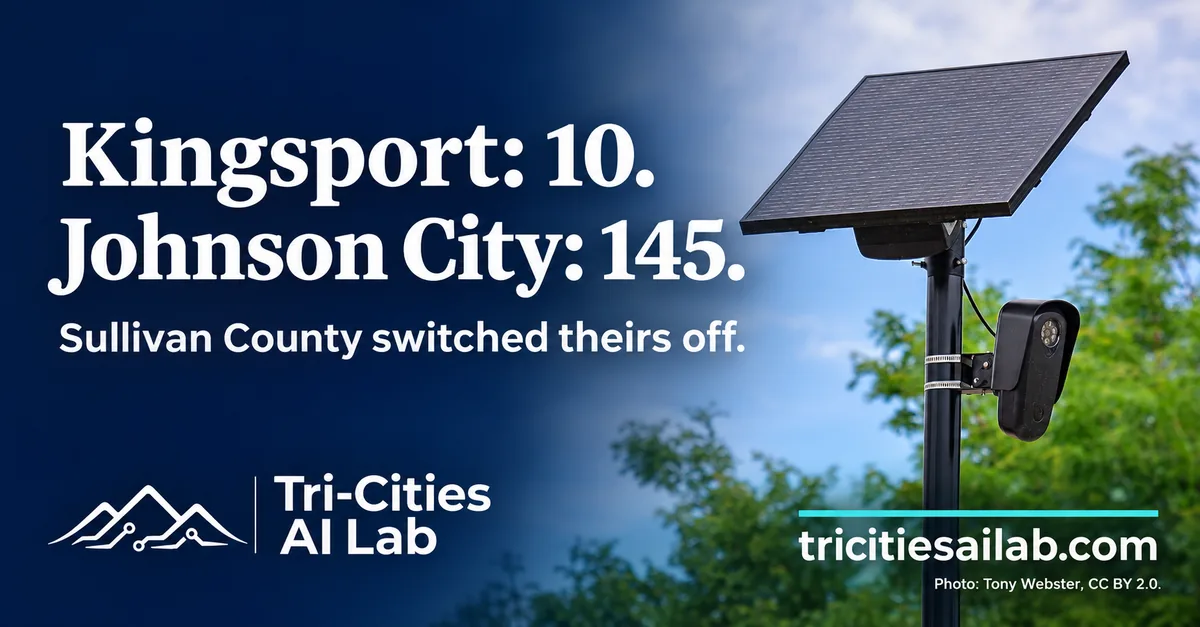
In the last 30 days, Johnson City's license plate cameras logged 616,590 different vehicles. Kingsport police ran 85 searches on theirs. Sullivan County's sheriff switched his off back in August.
Same region. Same company. Three different answers.
The company is Flock Safety, and if you've driven anywhere in the Tri-Cities lately, you've passed its cameras. They're the small dark boxes on poles near intersections and highway turnoffs, usually with a little solar panel on top. Once you know what they look like, you'll start seeing them everywhere. Sorry in advance.
This isn't a piece for or against the cameras. Plenty of people have that covered. It's about what the cameras actually do, who can search what they collect, what Tennessee and Virginia law allow, and how you can check your own city's setup. More of that is public than most people realize.
What the cameras actually do
"Flock camera" gets used for three different machines, and they don't do the same thing.
- License plate readers. These are the most common. When a car passes, the camera takes a still photo and logs the plate, the vehicle's make, model and color, and the time and place. Each read gets checked against hotlists of stolen cars, warrants and Amber Alerts. On the Kingsport and Johnson City portals, a hit has to be confirmed by a person before anyone acts on it.
- Video cameras. Johnson City also runs about 70 pan-tilt-zoom cameras that show live video, without audio, mostly downtown and near schools and parks. That's a Johnson City thing. A Sullivan County sheriff's captain told commissioners in August that the county's cameras had no live video and no audio, and Washington County's sheriff lists its 15 readers as "non-live view capable."
- Gunshot sensors. Johnson City's agreement includes these too. According to the Johnson City Press, they analyze sound in rolling windows of about three seconds.
None of the local agencies say they use facial recognition, and Johnson City's portal lists facial recognition, people, gender and race among the things the system doesn't detect. That's accurate as far as it goes. But Johnson City's own audit logs, obtained by the Johnson City Press, show officers used a "text prompt" feature to search for people by description 19 times in one month this summer. One search was for a "white female wearing black pants and a black sports bra." That isn't facial recognition. It isn't nothing, either.
Three neighbors, three answers
| Kingsport | Johnson City | Sullivan County Sheriff | |
|---|---|---|---|
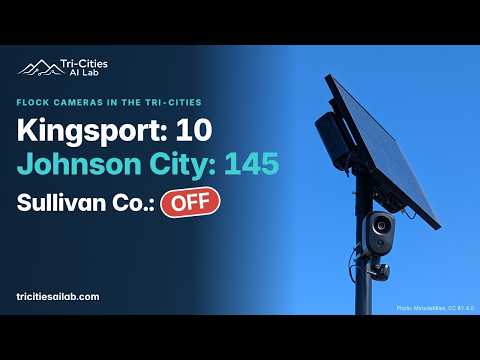
| Cameras | 10 plate readers | 221 (145 plate readers, 70 video cameras, 6 on two trailers) | 10 plate readers, all on state highways |
| Live video | None listed | Yes, on the video cameras, no audio | No, per the sheriff's office |
| Data kept | 30 days | 30 days (written policy allows 90) | 30 days, before the shutoff |
| Searches, last 30 days | 85 | 329 | Use suspended since Aug. 17 |
| Outside agencies that can search | Not published | 148 Tennessee agencies plus TVA Police | Not published |
| Public portal | Yes, with its full written policy | Yes, plus a city FAQ page and a 30-day search log | Not found |
| Where it stands | Active | Active, with new commissioners seated in December | Not being renewed in January 2027 |
Sources: Flock transparency portals for Kingsport and Johnson City (both updated Nov. 24, 2026); Johnson City's Safe City Project page; Johnson City Press, Aug. 30, 2026; Sullivan County Sheriff's Office via WCYB, Aug. 17, 2026; Sullivan County Commission work session, Aug. 13, 2026; Sullivan County Commission minutes, Aug. 20, 2026. Johnson City camera counts are from August. Portal figures are from Nov. 24, when Johnson City's portal listed 149 plate readers.
Sullivan County turned its cameras off
The Sullivan County Commission approved the sheriff's Flock cameras in August 2024 on a 19-1 vote, and they went live in February 2025. The first year cost $34,000 out of drug fund money, with $30,000 a year in maintenance after that, according to the Kingsport Times News. By December 2025 the sheriff's office said the cameras had helped find seven stolen vehicles and 12 wanted people, plus a woman under a TBI Silver Alert who turned up in North Carolina.
Then came August. At an Aug. 13 work session, Commissioner Joe Carr told a Flock representative the company's CEO should be hanged for treason, and the chairman cut him off. That made headlines well beyond Blountville. Four days later, Sheriff Jeff Cassidy suspended the cameras, citing threats against his staff and family, and said the public should decide their future. The county's elections administrator said the commission doesn't have the authority to call that kind of referendum.
On Aug. 20 the commission voted not to renew the contract when it comes up in January 2027. The official minutes show 18 yes, 1 no, 2 abstaining and 3 absent. It was closer than that looks. A motion to table the resolution failed 10 to 11 first.
The worry wasn't only about the sheriff's office. Zane Vanover, then mayor-elect and now county mayor, told WCYB he didn't want anyone building "a dossier built on someone just because of where they shop." Carr has since proposed a countywide ban on plate readers that would kick in only if the state or Congress ever gives counties that power. It's been put off until April 2027.
Johnson City went big, then tightened up
Johnson City approved its Flock agreement, which the city calls the Safe City Project, in July 2025. It's a 10-year deal worth $8,063,000. The first year was $300,000 from the police drug fund. The second year costs nothing. Every year after that runs $970,375. In August, Deputy Chief Mike Adams told the city commission the department had 145 plate readers, about 70 video cameras and two camera trailers, 221 police-run cameras in all. Kingsport, for comparison, has 10.
The city then tightened access in steps. Patrol officers lost search access Aug. 10, which left about 50 authorized users. On Aug. 20 the department turned off sharing with agencies outside Tennessee. Except it didn't, entirely. A feature called Nationwide Lookup was still switched on, which let any Flock agency in the country search Johnson City's cameras with a full plate number. Nobody caught it until Sept. 14, when a phone call to the vendor turned it up. "It was an oversight on my part," Adams told the Johnson City Press. Audit logs the paper obtained show outside agencies ran nearly a million searches on Johnson City's network from late July to late August, from at least 29 states.
Since then, the city cut the allowed search reasons from 47 to 37 for its own officers and to 16 for other Tennessee agencies, and started requiring a case or dispatch number on every search. Its written policy still allows data to be kept for 90 days, but the department keeps it for 30.
The politics are shifting too. The Press reported in October that the local Republican and Democratic party leaders both called for ending the contract, and seven of 10 commission candidates opposed it. On Nov. 3, voters elected two new commissioners, former mayor Pete Paduch and Dave Adams (not to be confused with Deputy Chief Mike Adams). Adams, who won the second seat by fewer than 100 votes, has been a consistent critic of the program. "We're gonna de-Flock Johnson City," he said after the win. Both take office Dec. 7. Commissioner Joe Wise has asked for a work session on the program before budget talks start in January.
Deputy Chief Adams, for his part, has called the system "the best thing since fingerprinting." The department credits it with helping recover more than $300,000 in stolen property since March 2025. He has said JCPD hasn't had any misuse, and that he'd recommend firing any officer who misused it.
If you want to hear it from the department, video of the Aug. 20 work session is on YouTube. The camera counts come up about nine and a half minutes in.
Kingsport kept it small and wrote it down
Kingsport has used Flock since at least 2023 and still has 10 plate readers. Its transparency portal is the most complete in the region. It posts the department's full written policy, which requires a case number on every search, makes the watch commander log any search done for another agency, caps retention at 30 days and audits searches monthly, including with Flock's automated tool that flags unusual activity. The portal also lists the department's own results. As of Oct. 31, it credits the cameras with $701,289 in stolen property recovered, 155 arrests and 376 charges, plus three homicide suspects, 30 fugitives and 10 missing people located.
Two things Kingsport doesn't publish are where its cameras are and who outside the department can search them. When the Times News asked for locations, Cpl. Brandon Arnold said, "For operational security reasons, we do not provide the locations of the cameras." The city clerk pointed to the state law that makes captured plate data, including GPS location, confidential.
As for sharing, Kingsport's portal is silent, but Kingsport shows up on other agencies' portals. Shelby County's sheriff lists Kingsport TN PD among the agencies with access to its cameras, so Kingsport is part of the statewide network in at least one direction.
The rest of the region
Washington County's sheriff has 15 plate readers and now keeps data for 7 days, the new default Flock announced in August. Carter County's sheriff and the Elizabethton, Erwin and Johnson County agencies all show up on Johnson City's list of sharing partners. Bristol, Tennessee, has 17 license plate readers, but they're Motorola, not Flock, and Bristol keeps data for 90 days, the state maximum.
Other places have pulled back or passed. Jonesborough rescinded a Flock approval in September before signing a contract. Damascus, Virginia, voted in October not to renew. The sheriffs in Hawkins, Greene and Unicoi counties had no plate readers as of August, and Greene County Sheriff David Beverly told the Greeneville Sun, "I'm not going to use them." And in Knox County, commissioners voted unanimously in August to remove about 143 of them.
Sources: Johnson City police, Aug. 20, 2026, via the Johnson City Press; WCYB regional inventory, Aug. 4, 2026; Sullivan County Sheriff's Office, Aug. 17, 2026; Johnson County Sheriff's Office portal. Hawkins, Greene and Unicoi sheriffs reported none.
Who can search your plate
The part most people don't realize is that sharing is a setting. Each agency owns its data and decides who else can search it, and that list can be long.
Johnson City's portal names every agency that can search its cameras. Right now that's 148 Tennessee agencies, including campus police at ETSU, Northeast State and Walters State, plus one federal agency, TVA Police. Kingsport's portal doesn't list anyone. Washington County's portal no longer shows a list.
It works in the other direction too. Johnson City's public search log shows that in the 30 days ending Nov. 23, about three in 10 of its officers' searches reached 100 or more camera networks at once, and one reached 1,471. Washington County's log shows more than half of its 70 searches did the same. When your local department runs a plate, it usually isn't only checking its own cameras.
Connor Beske, who runs the DeFlock Johnson City page, put the concern this way to the Johnson City Press. The cameras collect "information about us that they would otherwise need a warrant to get." The departments' answer is that each search now needs a reason and a case number, and every search is logged.
What they actually search for
Both Johnson City and Washington County post a downloadable log of every search from the last 30 days. It shows the date, how many networks the search reached and the reason given. It doesn't show plates or names. I pulled both on Nov. 25.
Source: Johnson City TN PD Flock transparency portal, public search audit, downloaded Nov. 25, 2026.
Download the search logs
These are the files exactly as each agency's portal provided them on Nov. 25, 2026. The portals only show the last 30 days, so these searches will no longer be on the portals by late December. Each row is one search, with the date, how many camera networks it reached and the reason given. No plates or names.
- Johnson City TN PD, Oct. 25 to Nov. 23, 2026 (CSV, 329 searches)
- Washington County TN Sheriff, Oct. 26 to Nov. 24, 2026 (CSV, 70 searches)
How I counted. A search that lists two reasons counts once under each, which is why the reasons add up to slightly more than the number of searches. "100 or more networks" counts searches whose network count is 100 or higher.
Washington County's 70 searches skew differently. Wanted people (24) and stolen vehicles (14) top its list. Two of its searches list "traffic infraction" as the reason, even though the same portal lists traffic enforcement as a prohibited use. Both list it alongside fleeing police, and both were run minutes apart on Nov. 1, which looks more like a chase than a speeding ticket. It's still the kind of question the public log exists to let people ask.
What the law says
Tennessee's rules are short. State law says government agencies can't keep captured plate data more than 90 days unless it's part of an ongoing investigation. A separate law makes that data confidential, so you can't request records of where a plate was seen. That confidentiality was set to expire, and lawmakers made it permanent this spring. A bill this year that would have tightened the rules didn't pass.
Tennessee Attorney General Jonathan Skrmetti said in September that the cameras are likely legal. "If you're collecting data in plain view for a limited purpose, it's probably okay," he told WVLT. He drew the line at using the data to build a picture of someone's routine, and said he expects the General Assembly to take it up, with some people wanting a ban and others wanting limits like short retention. The state's sheriffs and police chiefs associations have asked for clear rules, not a ban.
Virginia went further. Virginia law requires agencies to purge plate data after 21 days unless it's part of an ongoing investigation, prosecution or civil action. Search logs are kept for two years. Agencies can't feed the data into other states', federal or private databases, with limited exceptions, and both the data and the logs are exempt from Virginia's open records law. Agencies report their use to Virginia State Police each April 1, starting in 2027. I couldn't confirm which plate reader systems Bristol, Virginia, and the Washington and Scott County, Virginia, sheriffs use.
Sources: Flock default via WZTV; agency Flock portals; WCYB, Aug. 4, 2026; Tenn. Code Ann. 55-10-302; Va. Code 2.2-5517. Dark bars are legal limits.
When it goes wrong
As of Nov. 25, 2026, I found no publicly documented case of a Tri-Cities officer misusing these cameras. Elsewhere in Tennessee, the Institute for Justice, a public interest law firm that's suing over plate readers, has logged a few.
- Morristown. A Flock camera misread an "O" as a zero, and officers detained two grandparents at gunpoint while their 3-year-old granddaughter watched from the car. The camera was wrong, not the people.
- Oak Ridge. One officer got a three-day unpaid suspension for using Flock to track people on behalf of family members. A former officer faced 23 counts of official misconduct for misusing police data systems, Flock among them, for personal reasons.
The Morristown case is why the "human verified" rule on the portals matters. The Oak Ridge cases are why audits matter. And audits do sometimes work. In Shively, Kentucky, Flock's automated audit tool flagged an officer accused of searching for his child's mother thousands of times. That's the same kind of tool Kingsport's policy now requires.
Does it work?
Depends on what you mean by work.
For finding specific cars, the local agencies say yes, and they have numbers. Kingsport's 155 arrests and $701,289 in recovered property. Johnson City's $300,000-plus. Sullivan County's seven stolen vehicles and 12 wanted people. Those are the departments' own counts, not independent audits, but they're specific.
For preventing crime, the evidence is thinner. A randomized 2021 study of patrol cars with plate readers found more stolen cars recovered, but no more arrests and no clear crime deterrence. An August 2026 working paper comparing 216 agencies that adopted fixed Flock cameras with thousands that didn't found reported vehicle thefts fell 11 percent afterward. Its arrest results started moving before the cameras went up, which the authors flag themselves, and its deployment data comes from Flock.
So the honest answer is that the cameras clearly help find particular cars, and the case that they prevent crime is still being argued. People fighting about Flock are often answering different questions.
How to check for yourself
You don't have to take anybody's word for this, mine included.
- Look at the portals. Kingsport, Johnson City, the Washington County Sheriff and the Johnson County Sheriff all have one. Check the retention days, the camera count, the 30-day search count, whether there's a sharing list and whether there's a search log you can download.
- Read the policy. Kingsport posts its full general order on its portal. Johnson City posts its policy and an FAQ on its Safe City page, and takes questions at SafeCity@johnsoncitytn.org.
- Ask for records. Tennessee residents can request contracts, policies and search audit logs under the Public Records Act. The plate data itself is off limits. For a sense of cost, Johnson City quoted the Johnson City Press $150 for a month of audit logs and $500 for a year, and Washington County quoted $112 for a year of sheriff's office logs.
- Show up. City and county commissions decide whether these contracts get funded. That's where every decision in this piece was made.
What to watch next
- Dec. 7. Johnson City's new commissioners take office.
- January. Johnson City's budget talks start. Sullivan County's contract comes up and won't be renewed. The Tennessee General Assembly convenes, and the attorney general expects plate readers to be on the agenda.
- April 1. Virginia agencies' first plate reader reports are due.
- April. Sullivan County takes up its proposed trigger ban again.
The bottom line
Three neighbors looked at the same technology and made three different calls. Sullivan County shut it off. Johnson City built the biggest system in the region and is now rethinking parts of it. Kingsport kept it small and wrote down its rules. You can argue about which one got it right, and people will. But you don't have to argue in the dark. The camera counts, the retention settings, the search logs and the policies are public, and they're worth reading before the next vote.