

I spent this past weekend reading through the research on a word that has been following AI around all year: slop. If you have spent any time online lately, you have seen it. The strange videos. The product photos that fall apart if you look too closely. The articles that say a lot and mean nothing. People are annoyed, and a fair number of them have decided the whole thing is junk.
What struck me is how the word splits people into two camps. One camp is a little afraid of AI, sure it can do anything. The other has written it off completely after seeing it do one thing badly. Both reactions come from the same place: not knowing where the line is. So I went looking for where that line actually sits, and the answer turned out to be clearer than I expected.
The word itself tells you something
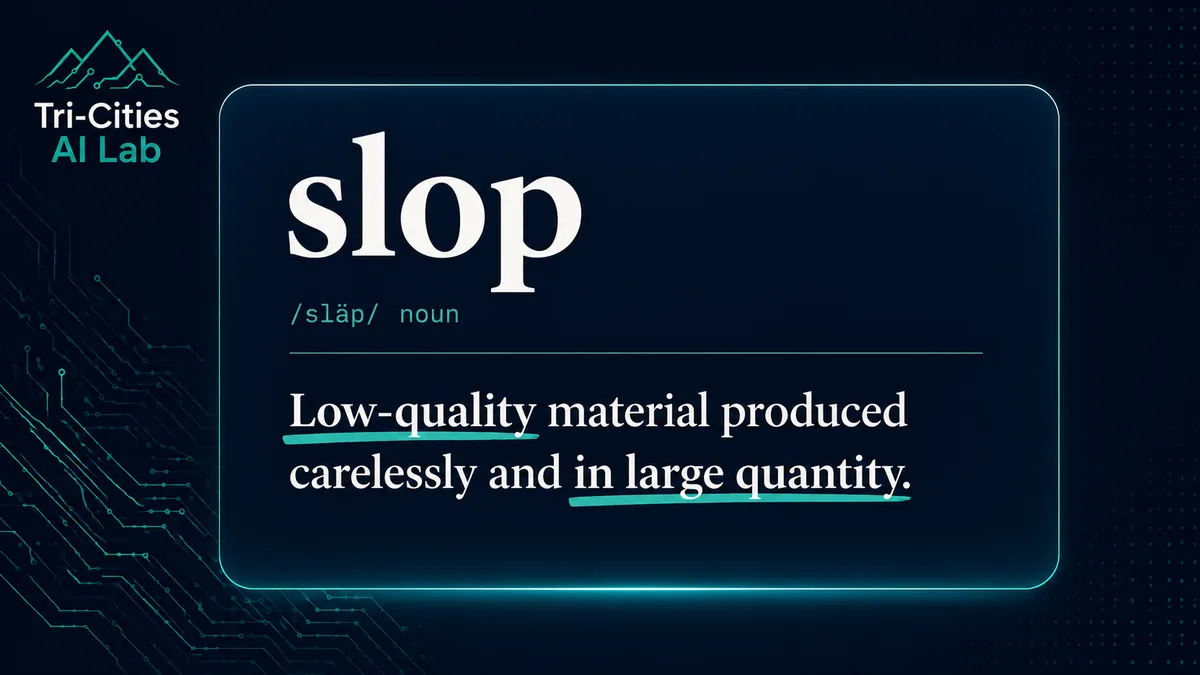
"Slop" is Merriam-Webster's 2025 Word of the Year. The dictionary defines it as digital content of low quality that is produced in quantity by means of artificial intelligence.
Read that definition again. It does not say AI output is slop. It says low quality, made in bulk, is slop. The quality and the quantity are the problem. The machine is just how it was made fast.
That is the whole point in one sentence, and the rest of what I read only backed it up.
Why AI makes mistakes in the first place
Here is the part worth understanding, and it takes about thirty seconds. A tool like ChatGPT does not look facts up in a database. It predicts the next most likely word, over and over, based on patterns it learned from a huge pile of text. It is very good at sounding right. It has no built-in sense of whether it is right.
So when it does not know something, it does not stop and tell you. It fills the gap with something that looks correct. People call this a "hallucination." The important thing for a business owner is this: the mistakes are not a glitch that will get patched away. They come with the territory. The only thing that reliably catches them is a person who knows the subject, reading the work before it goes out.
What actually goes wrong
When I lined up the real cases, the pattern was the same every single time. Somebody let the AI's first draft walk out the door as if it were finished work.
- In May 2025, a syndicated summer reading list ran in the Chicago Sun-Times and the Philadelphia Inquirer recommending books that do not exist, by real authors who never wrote them. The newsrooms had no hand in it. An outside vendor used AI and nobody checked the list.
- A popular news app, NewsBreak, published a story about a shooting in a small New Jersey town. Local police said no such shooting ever happened. The AI made it up.
- A reporter at a small Wyoming newspaper used AI to invent quotes, including words it put in the governor's mouth, and resigned once a competitor caught it.
- On Amazon, a wave of AI-written mushroom foraging guides gave dangerous advice, including telling readers to identify mushrooms by taste. That is the kind of error that can put someone in a hospital.
- Two lawyers filed a brief citing court cases that did not exist, because ChatGPT invented them. They were fined.
None of these was caused by some exotic AI failure. Every one of them was a person hitting publish without doing the one job the AI cannot do for them.
The catch: a glance is not enough
Here is where I have to be honest, because it is the part most articles skip. "Just have a human check it" is the right idea, but a lazy version of it will still burn you. The AI is built to sound confident and helpful, and that works on us.
In that lawyer case, the attorney actually did try to verify. He asked ChatGPT whether the cases were real. It assured him they were. It was lying in the calm, professional tone of something that had no idea it was wrong.
It gets more pointed. Researchers at Harvard Business School watched professionals push back on AI answers they doubted, and found the AI did not back down. The harder people challenged it, the harder it defended its original answer, piling on reasons and even flattery. Checking the AI by asking the AI is not checking. Real review means holding the work up against something you can trust: a real source, a real record, your own knowledge of the subject.
What it looks like when it is done right
This is the encouraging half, and it is just as well documented. When AI drafts and a knowledgeable person reviews, the results are genuinely good.
In a 2025 study of 263 clinicians across six health systems, doctors used an AI tool to draft the first version of their patient notes, then reviewed and edited every one before it counted. After thirty days, the share of clinicians reporting burnout dropped from about 52 percent to 39 percent. The paperwork got faster and the doctors got their attention back, because the AI handled the rough draft and the humans kept the judgment.
A separate hospital study showed both sides of the coin at once. Most AI-drafted replies to patients were fine to send. But a small fraction, if they had gone out unedited, could have seriously harmed someone, usually because the draft failed to tell a patient to seek emergency care. The review step was not a formality. It was the whole safeguard.
What this means for your business
You do not need a policy binder. You need one habit. Use AI freely for the rough, repetitive, get-me-started work: a first draft of an email, a starting point for a description, an outline, a summary. Then, before anything goes out under your name, a person who knows the subject reads it against reality.
A simple test works for almost every situation: if the output could embarrass you, mislead a customer, or create a legal headache, the AI cannot be the one who signs off on it. That is not a knock on the tool. It is just knowing what the tool is for.
So the next time someone tells you AI is all slop, you can tell them the truth. The slop was never the AI. It was the step somebody skipped. Keep that step, and a fast, sometimes-wrong assistant becomes one of the most useful things in your week. That review step is exactly what an AI Strategy engagement builds into your workflow. Tell us what is slowing you down.
Sources
Merriam-Webster, 2025 Word of the Year. Harvard Business Review, on AI "persuasion bombing," March 2026. JAMA Network Open, ambient AI scribe study, October 2025. Mass General Brigham / The Lancet Digital Health, patient-messaging study, April 2024. Reporting on the cases above appeared in the Chicago Sun-Times, Reuters, the Associated Press, and WIRED.