

A while back, I was on a video call teaching a small training class for my day job at Barrister Intelligence. We do OSINT and investigative work for law firms. It's the kind of work where if you get a fact wrong, somebody's case takes a hit. Real consequences. So when I show people how I use AI in that work, the room tends to get quiet and skeptical fast.
One of the men in the class had decades of law enforcement experience behind him. He's also a published thriller author, the kind of person who has built a career on getting details right. We were halfway through our second session together when he stopped me to tell me a story.
He and his son had both tried AI before. They hated it. The answers were generic. The writing sounded fake. It got things wrong. As far as he was concerned, the whole thing was overhyped.
Then he sat through a class and a half of watching me work.
He told me, right there, that I had completely changed his mind. Not because I argued with him. Not because I tried to sell him on it. Because he watched me use it, and what he saw didn't look anything like what he'd tried on his own.
Here's what I think the difference was.
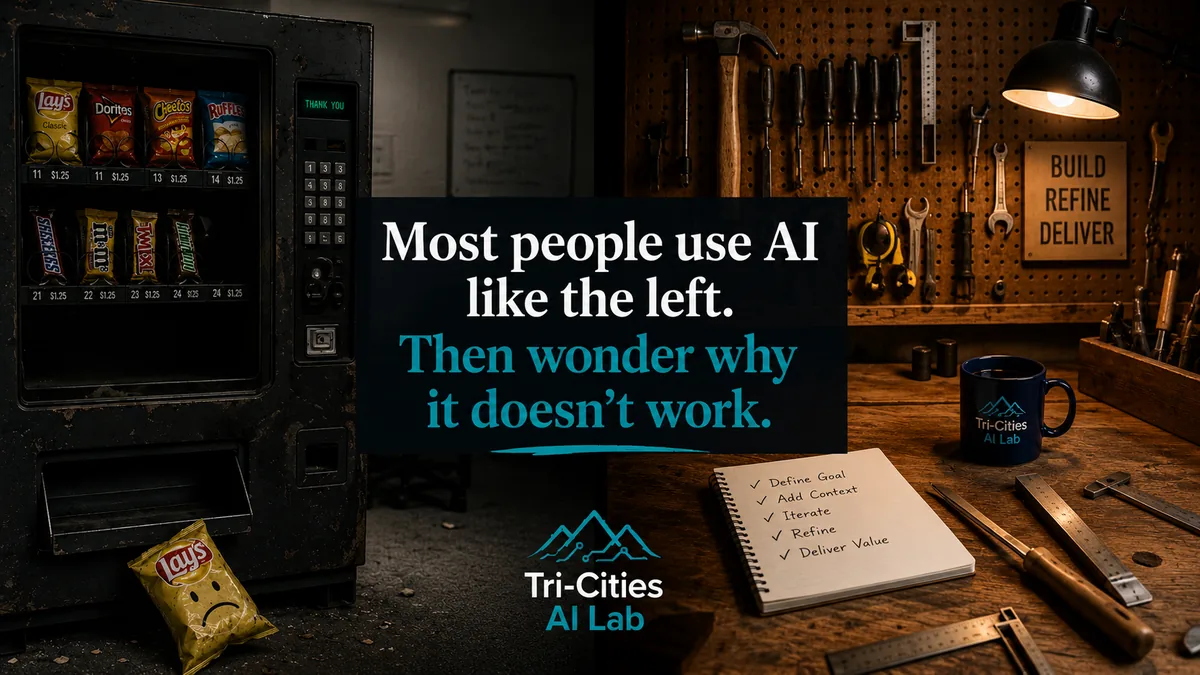
Most people who try AI and walk away disappointed are using it like a vending machine. They walk up, punch in a request like "write me a blog post about my business," and expect a finished product to drop out the bottom. When the result is generic, bland, or wrong, they shrug and say "see, AI is garbage."
I get it. That's what the hype told them to expect. Push a button, get a miracle.
But that's not what the tool actually is. A vending machine gives you whatever's already in it. A real tool does what you guide it to do. A circular saw doesn't cut a straight line on its own. A camera doesn't take a good photo on its own. And AI doesn't write something useful on its own.
The gentleman in my class watched me do things he wasn't doing:
- I gave it context. Who I was, who the work was for, what the end product needed to look like, what tone and standards mattered.
- I gave it real source material. Not "write about X," but "here's the actual document, the actual case file, the actual transcript. Work from this."
- I pushed back when it gave me something weak. I told it why it was weak. I made it try again.
- I read every word it produced and decided what stayed, what got cut, and what got rewritten in my own voice.
- I treated it like a sharp junior analyst who needed direction, not a magic oracle that produces finished work on demand.
What he saw wasn't AI doing my job. It was AI making me faster at my job, while I stayed in the driver's seat the whole way.
That's the part the hype people leave out. And it's the part the "AI is slop" people leave out too. Both crowds are reacting to the same misunderstanding from opposite sides. One thinks the vending machine works. The other tried it, got a stale candy bar, and concluded the building is broken.
The building is fine. The vending machine was never the right thing to use.
Why this matters for your business.
If you run a small business in the Tri-Cities and you've tried AI and walked away unimpressed, I believe you. Your experience was real. But I'd bet a steak dinner you were using it like a vending machine. Most people are. Even people much younger than the gentleman in my class. Even people in tech.
The good news is the fix isn't technical. It's a different posture. Slowing down. Giving it context. Treating it like a tool you're operating instead of an answer machine you're consulting.
That's most of what I do when I work with local businesses. I'm not selling magic. I'm showing owners how to operate the tool so the output actually saves them time instead of wasting it.
If you've written AI off, I won't argue with you. I'll just ask the same thing I asked that retired detective:
Watch me use it for ten minutes before you decide.
That's usually all it takes.
Curious what this looks like for your business? Reach out here. The first conversation is free. Or start with AI Strategy if you want a structured first step.